CV for UAE and Saudi Jobs: A Guide to Egypt and the Gulf
How to write a CV for jobs in the UAE, Saudi Arabia, Qatar, Kuwait, Bahrain, Oman and Egypt: personal details, attestation, notice period, salary and length.
Updated October 17, 2026
A CV that works in London or Toronto needs some changes before it goes to Dubai, Riyadh or Doha. Gulf employers often want details that Western CVs leave out, like nationality, visa status and notice period. At the same time, multinational companies in the region screen CVs with applicant tracking systems and ask for less personal information than local firms do. This guide covers what to include, what to leave out and how to handle the paperwork questions that come up when you apply from abroad.
It applies to the six Gulf states (the UAE, Saudi Arabia, Qatar, Kuwait, Bahrain and Oman) and to Egypt, where many regional companies also hire. Practice varies by country, sector and employer, so treat the points below as common habits, not rules.
The Gulf CV at a glance
| Topic | Common practice |
|---|---|
| Language | English for most private sector jobs; Arabic or both for some government roles |
| Length | One to two pages |
| Photo | Common at local firms, optional at multinationals |
| Personal details | Nationality, visa status or location, notice period, driving license if relevant |
| Salary | Left off the CV; given only when asked |
| Certificates | Attestation usually needed before the work visa, not to apply |
| File | PDF named with your name and target role |
English, Arabic or both
Write the CV in the language of the job post. In the UAE, Qatar and Bahrain, most private sector roles are advertised in English because teams are international. Saudi Arabia, Kuwait and Oman have a mix, and government or semi-government bodies lean toward Arabic or ask for both. In Egypt, multinationals, banks and tech companies work in English, while many local firms accept Arabic.
If a role asks for both versions, keep them identical in content: the same jobs, dates and numbers. Don't run your CV through a translation tool and send the result. Arabic job titles and phrasing have conventions, and a recruiter who reads both languages will notice odd wording. Arabic is written right to left, and a CV built in a tool that doesn't support it can show reversed dates, broken punctuation and disconnected letters.
Personal details that are common in the region
This is where a Gulf CV differs most from a Western one. Local employers often expect these details, while multinationals ask for fewer. Include what helps the employer make a hiring decision and leave out what has nothing to do with the job.
| Detail | Include it? |
|---|---|
| Nationality | Usually yes, as it affects visa processing |
| Current location and visa status | Yes, for example "Dubai, UAE, residence visa" or "Manchester, UK, willing to relocate" |
| Notice period | Yes, for example "Available immediately" or "One month" |
| Driving license | Yes if the job involves driving, such as sales or site work; say which country issued it |
| Date of birth | Optional; many applicants now leave it off |
| Photo | Optional; common at local companies |
| Marital status | Optional; can matter if the package includes a family visa |
| Religion, passport number | Leave them off |
Visa status and location
Recruiters in the Gulf often sort candidates into those already in the country and those who need a new visa. Someone already in the UAE on a transferable residence visa can sometimes start sooner. If you are abroad, say where you are and that you are willing to relocate. Sponsorship and visa transfer rules differ between countries and have changed in recent years in several of them, so state your situation plainly and leave the legal details for the conversation.
Notice period
Notice periods in the Gulf are often one to three months, depending on the contract. Recruiters ask early because it affects start dates and visa timing. If you can start right away, say so.
Photo and date of birth
A professional photo is still expected by many Gulf and Egyptian employers, especially for client-facing roles. Multinationals increasingly prefer CVs without one, and some applicant tracking systems handle images poorly. If you add a photo, use a plain background and business clothing. Date of birth follows the same trend: once standard, now often left for the application form.
Degrees, grades and attestation
List your degree, subject, university, country and year. If your university is not well known in the region, adding the country helps. Grades are optional once you have a few years of experience; if you include them, use the scale your university uses, for example "First Class Honours" or "GPA 3.6/4.0", rather than converting them.
Certificate attestation
Most Gulf countries ask for your degree to be attested before they issue a work visa or permit. The chain usually runs through authorities in the country that issued the degree and then the embassy or foreign ministry of the country where you will work. Some countries also ask for an equivalency certificate from their ministry of education for certain jobs, especially in government, health and education. The steps differ by country and profession and change from time to time, so check the current process with your employer or the relevant embassy.
On the CV, a short note under the degree is enough if it is already done: "Degree attested for UAE employment." It tells the employer your hiring won't be held up by paperwork. If you haven't started, don't mention it, but begin early if you are serious about moving.
Professional licenses
Many professions need a local license or registration before you can start work in the Gulf. Health workers usually need a license from the health authority of the country or emirate, often with an exam and verification of your documents with the institutions that issued them. Engineers in Saudi Arabia register with the Saudi Council of Engineers. Accountants and auditors may be asked about recognized qualifications such as ACCA, CMA or CPA.
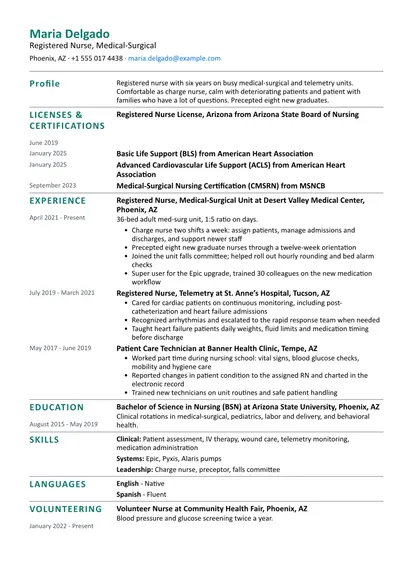
If you already hold a Gulf license or have passed the exam, put it near the top of the CV. If an application is in progress, say so honestly: "DHA license application under review." The registered nurse template has a clear place for license numbers and expiry dates.
Saudization and Emiratization
Every Gulf state has policies to increase the number of citizens working in the private sector: Saudization (Nitaqat) in Saudi Arabia, Emiratization in the UAE, and similar programs in Qatar, Kuwait, Bahrain and Oman. In Saudi Arabia some job titles are reserved for citizens, and companies work to localization quotas that depend on their sector and size. In the UAE, private companies above a certain size have targets for hiring Emiratis.
In practice, this means some job posts are open only to nationals, while technical, engineering and healthcare roles still recruit internationally in large numbers. Read the post carefully. If you are a Gulf national, put your nationality clearly at the top, since it can be a direct advantage.
Salary expectations
Don't put a salary on the CV. It stays in circulation for months and reaches different companies, and a number that suits one can rule you out at another. When an application form asks, give a realistic range.
Gulf packages usually combine a basic salary with allowances for housing and transport, and sometimes flights home, schooling and medical insurance. End-of-service gratuity is often calculated on the basic salary only, so be clear whether you are quoting basic or total. Look up typical pay for your role and country before you name a figure; costs of living differ a lot between, say, Dubai and Muscat.
Length and section order
One page suits graduates and people with a few years of experience. Two pages are fine for longer careers or for professions with many licenses and certifications. A clear order:
- Name, target job title and contact details, with your phone number in international format
- Short personal details: nationality, location or visa status, notice period
- A two or three sentence summary
- Work experience, newest first
- Education
- Licenses, certifications and memberships
- Skills
- Languages, with a level for each
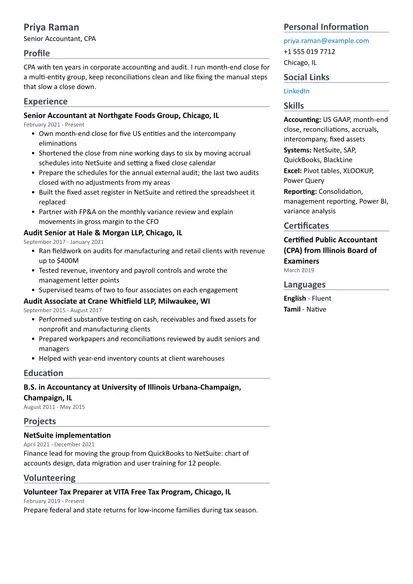
In experience bullets, start with a verb and end with a result. If a previous employer is unknown in the Gulf, add one line about what it does and how big it is. The accountant template shows this style.
Job boards and LinkedIn habits
People in the Gulf and Egypt look for work through several channels at once:
- Regional and local job boards: some cover the whole Gulf, others focus on one country. Many ask you to fill in a profile as well as upload a CV, so keep the two consistent.
- LinkedIn: widely used in the UAE, Saudi Arabia, Qatar and Egypt, especially for office, technical and management roles. Recruiters search it directly, so use a clear headline and set your location or target country.
- Recruitment agencies: they play a large role in nursing, engineering, hospitality and sales. A clear English CV with complete personal details makes their job easier.
- Referrals: introductions from former colleagues carry real weight in the region. Send your CV when someone offers to pass it on.
Be careful with offers that ask you to pay for a job or a visa. Genuine employers don't charge candidates for hiring.
Build your CV for free
You can build your CV in the resume builder on resumeforfree.com for free, without an account. It produces a clean English CV as a PDF and can also make an Arabic version laid out right to left with proper Arabic fonts, keeping email addresses and phone numbers readable. Your data stays in your browser unless you choose to sync. Since many Gulf employers screen with tracking software, the ATS-friendly resume guide is worth reading too.
Mistakes to avoid
- Leaving out nationality, location and notice period for a Gulf role
- Listing religion, passport number or parents' names
- Pasting a machine-translated Arabic CV without a check by a fluent speaker
- Writing a salary figure on the CV
- Assuming a home-country license lets you work right away in the Gulf
- A phone number without the country code
- A Word file named "CV final new"
Checklist before you send it
- The CV language matches the job post
- Nationality, location or visa status and notice period are on one clear line
- Degrees list the university and country, and any attestation already done is noted
- Licenses and registrations are visible near the top if your profession needs them
- No salary on the CV
- The file is a PDF with your name and role, for example "Sarah-Collins-Registered-Nurse.pdf"