German CV Format: How to Write a Lebenslauf (2026)
How to write a German CV for jobs in Germany: the tabular Lebenslauf, photo, personal details, grades, language levels, degree recognition and the full application.
Updated October 17, 2026
A CV for a job in Germany is called a Lebenslauf, and it looks different from a US resume or a UK CV. It is tabular, often has a photo, lists dates with month and year, and is usually sent together with a cover letter and copies of your certificates and references. This guide explains what German employers expect in 2026, what has become optional, and what people moving to Germany from abroad should add, such as degree recognition, work permit status and German language level. Austria and Switzerland follow mostly the same rules, and the differences are noted where they matter.
You can build a Lebenslauf in our free CV builder without an account. It supports a photo, lets you set the CV language to German so all section headings are in German, and exports a PDF.
German CV at a glance
| Section | What goes in | Required? |
|---|---|---|
| Personal details (Persönliche Daten) | Name, city or address, phone, email | Yes |
| Photo (Bewerbungsfoto) | Professional headshot | No, optional |
| Profile (Kurzprofil) | Two or three sentences about you | Optional, but useful |
| Work experience (Berufserfahrung) | Jobs, newest first, with month and year | Yes |
| Education (Ausbildung, Studium) | Degrees, vocational training, grades for graduates | Yes |
| Further training (Weiterbildung) | Courses, certificates, licences | If you have them |
| Skills (Kenntnisse) | Technical skills, software, languages with CEFR level | Yes |
| Interests (Interessen) | One or two specific hobbies | Optional |
| Place, date, signature | At the end | Optional, depends on sector |
The tabular Lebenslauf
The standard German CV is tabular: the time period on the left, the role or school on the right, and a few bullet points underneath for each job. It runs in reverse chronological order, so your current or latest job comes first. The old style of starting with primary school is gone. List only your highest school leaving certificate, and only in one line once you have a degree or work experience.
Use month and year for every date, for example "03/2021 to present" or "since 03/2021". Writing only years makes recruiters wonder what you are hiding, because "2022 to 2023" can mean two months or two years. German recruiters check dates closely, and gaps of a few months will be noticed.
Personal details: what is required and what is optional
Only contact details are required: full name, phone number with country code, email address and at least your city. If you already live in Germany, a full address is fine. If you are applying from abroad, write your current city and country, and add that you are willing to relocate.
Everything else is optional. Germany's General Equal Treatment Act (Allgemeines Gleichbehandlungsgesetz, AGG) protects applicants against discrimination based on ethnic origin, sex, religion or belief, disability, age and sexual identity. As a result, many employers no longer ask for date of birth, marital status, religion or a photo, and you do not have to give them.
| Detail | Current practice |
|---|---|
| Date and place of birth | Optional. Many people leave it out, but you will still see it on many German CVs. |
| Marital status and children | Optional and less common now. Leave it out unless you want to include it. |
| Nationality | Optional. For applicants from outside the EU, your work permit status matters more than nationality. |
| Work permit or visa | Strongly recommended if you are not an EU citizen. See below. |
| Religion | Only for church employers, such as Caritas or Diakonie. |
To be honest about current practice: the AGG did not make these details disappear. Plenty of German CVs still include a date of birth and a photo, and nobody is rejected for that. Look at the company. A mid-sized engineering firm in Bavaria will expect a classic Lebenslauf, while an international start-up in Berlin is more likely to prefer a lean one without personal details.
Work permit status for non-EU applicants
If you need a visa, recruiters want to know early whether hiring you is realistic. Add one line under your personal details:
- "Work permit: EU Blue Card, valid until 08/2028"
- "Residence permit with unrestricted work authorisation"
- "Eligible for the EU Blue Card, degree listed as equivalent in anabin"
- "Opportunity Card (Chancenkarte), available from 01/2027"
Do not overstate your status. If you still need a visa, say that your degree is recognised and when you could start, and let the employer ask.
The photo
A photo is optional but still widespread in Germany, and even more common in Austria and Switzerland. If you add one, make it professional. A holiday photo or a selfie does more harm than no photo.
- Head and shoulders, looking at the camera, with a friendly expression.
- Plain, calm background.
- Clothes you would wear to an interview in that field.
- Recent, so it still looks like you.
- Placed at the top right next to your personal details, or in the header.
Leave the photo off for international corporations, for companies that use anonymous applications, and whenever the job ad asks you to.
Work experience
For each job, give the period, job title, company and city. If the company is unknown in Germany, add a short line about what it does and how big it is, for example "Logistics software for regional carriers, 200 employees". Below that, write two to five bullet points that start with a verb and show a result.
- Weak: "Responsible for the warehouse."
- Better: "Moved warehouse management to a new ERP system and cut stocktaking from three days to one."
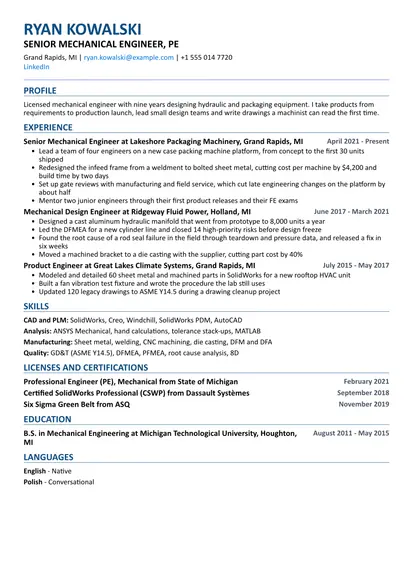
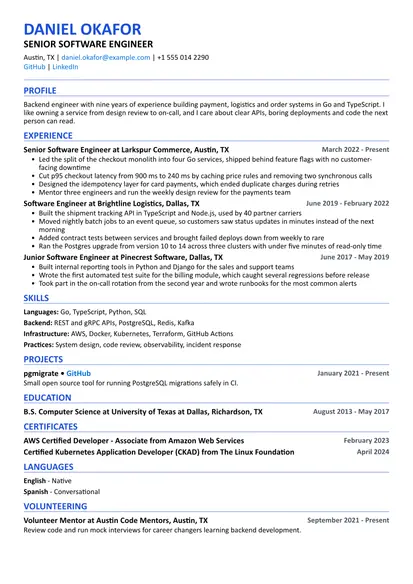
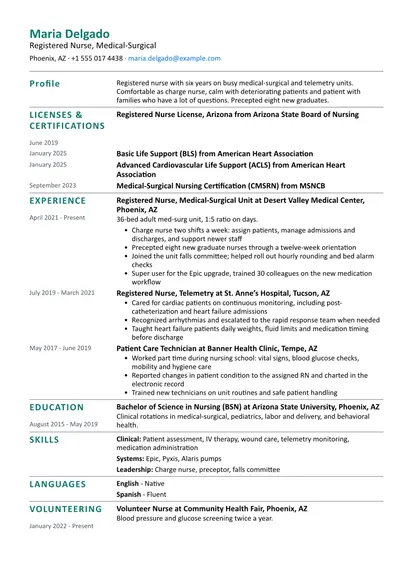
If your job title has no clear German equivalent, use a common English or German title that describes the work. For examples by profession, see our templates for mechanical engineers, software engineers and registered nurses.
Education and foreign degrees
Germany has two respected paths: vocational training (Ausbildung), which combines a company and a vocational school, and university study (Studium). Both belong on the CV with the same weight. For a degree, list the degree and subject, the university, the city and country, and the dates. Graduates add their thesis topic and grade.
Recognition of foreign degrees and anabin
German employers often do not know foreign universities. The anabin database, run by the Central Office for Foreign Education (ZAB), shows how foreign institutions and degrees compare to German ones. An institution rated H+ is recognised as a university, but that alone does not cover your degree. If your degree is also listed as equivalent to a German degree, you can add "anabin: institution H+, degree equivalent" next to it.
If your university or degree is not listed, you can apply to the ZAB for a statement of comparability (Zeugnisbewertung). It costs a fee and can take up to about three months once your documents are complete, but it helps with both employers and visa applications. For the EU Blue Card, most applicants need a recognised or comparable degree and a job offer above a minimum salary that is set each year. IT specialists can also qualify through work experience.
Regulated professions are different. Nurses, doctors, pharmacists, teachers and some engineering titles need formal recognition (Anerkennung) from a German authority before you can work under that title. Nursing recognition usually also requires German at B2 level. If your recognition is in progress, say so: "Recognition as Pflegefachfrau in progress, expected 03/2027".
Grades
German grades run from 1.0 (very good) to 4.0 (sufficient), and anything worse is a fail. Germans write decimals with a comma, so a German CV says "1,7", not "1.7". Recruiters cannot easily read foreign grade scales, so add the scale: "GPA 3.6 of 4.0" or "82 % (pass mark 50 %)". Do not convert grades yourself unless you have an official conversion. In Austria the scale is 1 to 5 with 4 as the lowest pass, and in Switzerland 6 is the best grade and 4 is a pass.
Language levels
Use the Common European Framework of Reference (CEFR, in German GER) for every language. "Fluent" means different things to different people, while "German B2" is clear.
| Level | Meaning |
|---|---|
| A1, A2 | Basic |
| B1 | Independent in everyday situations |
| B2 | Independent at work, including technical discussions in your field |
| C1 | Fluent, including complex professional discussions |
| C2 | Very high level, understands virtually everything with ease |
Name the certificate if you have one: "German B2 (Goethe-Zertifikat)", "German C1 (telc)" or "German, TestDaF level 4". If you are still learning, be precise: "German B1, B2 course in progress, exam 02/2027". Many jobs in Germany need at least B2 German for daily work, even in companies where meetings are in English. Leave out bars, stars and percentages, because nobody knows what "80 % German" means and applicant tracking systems cannot read graphics.
Gaps in your CV
German recruiters notice gaps. A few weeks between jobs needs no explanation, but from about three months, add a short, honest line. Moving countries is a perfectly good reason:
- "Relocation to Germany, intensive German course (B1 to B2)"
- "Parental leave"
- "Caring for a family member"
- "Waiting for visa and degree recognition"
- "Career break, online course in data analysis"
Keep it to one line. You do not need to give medical details.
Place, date and signature
German CVs used to end with the city, the date and a handwritten signature. Today this is optional. Most online applications, tech companies and international firms skip it. Public sector employers, trades, smaller companies and apprenticeship applications still often expect it. If you sign, use a scan of your real signature and make sure the date matches your cover letter.
Length and layout
One page for graduates and early career, two pages with more experience. Use one readable font at 10 to 12 points, clear headings and enough white space. Many German companies use applicant tracking systems that read text from your PDF, so a single-column layout without text boxes is the safest choice. Our guide to ATS-friendly resumes explains why.
The full application (Bewerbungsmappe)
In Germany, the CV is usually part of a package:
- Cover letter (Anschreiben): one page, written for this job. Some companies, especially in tech, have dropped it. Read the job ad.
- Cover page (Deckblatt): optional, with photo, name and the position. Rare in online applications.
- CV (Lebenslauf)
- Attachments (Anlagen): employment references, newest first, degree certificates and relevant certificates.
Employment references (Arbeitszeugnisse)
In Germany, employees have a legal right to a written reference when they leave (Section 109 of the Trade Regulation Act). A simple reference states the type and length of the job, and on request the employer must issue a qualified one that also rates performance and conduct. These references use coded language, where "always to our fullest satisfaction" means very good. Recruiters read them closely. If you worked abroad, attach reference letters from previous employers if you have them. Your home country probably has no such tradition, and German recruiters know that.
Translations
For a job application, English copies of certificates are often accepted. For formal recognition and visa procedures, authorities usually require translations by a sworn translator. Check the requirements before you pay for translations.
Europass or a normal CV?
The Europass CV is a standard EU format. It is useful for EU-funded projects, research positions and job ads that ask for it. For most private sector jobs in Germany, a normal tabular CV works better. Europass CVs tend to get long and look like a form, which makes it hard to put your strengths first. Its language self-assessment grid is still a good way to check your CEFR level honestly.
File format for online applications
- Send a PDF. Use Word only if the employer asks for it.
- Many companies want one PDF in the order cover letter, CV, attachments. Applicant portals often have a separate upload for each document.
- Portals often limit uploads to a few megabytes, so scan certificates at a normal resolution.
- Use a clear file name, such as "Lebenslauf-Priya-Sharma.pdf".
Austria and Switzerland
The structure is the same in all three countries. In Austria and Switzerland a photo and date of birth are more common. In Switzerland, foreigners usually state their nationality and permit type (such as B or C), and many CVs end with two or three references with name, position and phone number. Ask your referees first.
Getting started
- Open the builder and set the CV language to German.
- Upload a photo or leave it out.
- Add work experience and education in reverse chronological order, with month and year.
- Add your languages with CEFR levels and your work permit status.
- Check the preview, trim it to one or two pages and download the PDF.
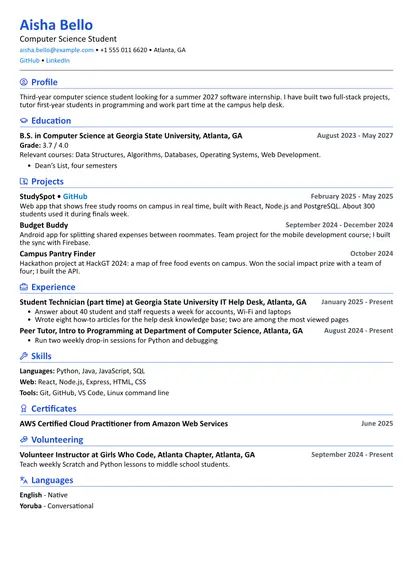
If you are a student or recent graduate, the student template puts education and projects first. If you are also applying in the Gulf, read our Middle East CV guide, because expectations there are different again.