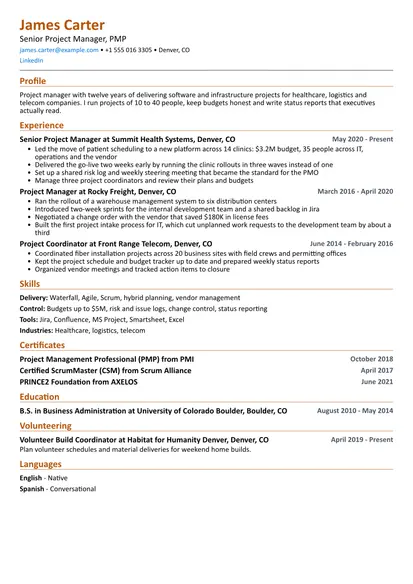
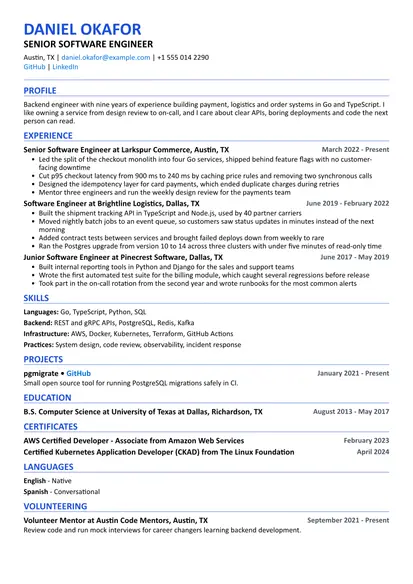
This template is built for mechanical engineers who design parts and systems, take them into production and test them. It uses the ATS Friendly layout: one column, plain headings and no graphics, which matters because large manufacturers in automotive, aerospace and industrial equipment almost always screen resumes through an applicant tracking system first. The sample belongs to a licensed mechanical engineer with nine years of experience in hydraulic equipment and packaging machinery. Replace it with your own work and delete any section you don't need.
Template at a glance
| Setting | This template |
|---|---|
| Layout | ATS Friendly, single column |
| Length | One page, two for long careers with many programs |
| Best for | Design, product, manufacturing, test, HVAC and process engineers |
| Section order | Summary, experience, skills, licenses and certifications, education, languages |
| Also works in | Compact (more jobs on one page), Default (for a side column of skills) |
What hiring managers look for
An engineering manager reading your resume wants to know what you designed, what it had to survive, and whether it worked once it left your screen. A list of software tells them very little. A bracket that passed a 2 million cycle fatigue test, a fixture that cut changeover time on the line, or a pump housing that moved from prototype to 10,000 units a year tells them a lot.
They also look for where you sit in the product cycle. Some engineers live in concept and analysis, some in drawings and release, some on the plant floor with suppliers and machinists. Most jobs lean toward one of these, so make your own place clear in the summary and in the first bullet of each job.
The first reader is often a recruiter who compares your resume against the job post. They search for tool names, processes and standards: SolidWorks, Creo, NX, CATIA, ANSYS, GD&T, ASME Y14.5, DFMEA, injection molding, sheet metal. Write the ones you have used plainly, and spell them the way the job post does.
How to write each section
Header and contact details
Your name, the job title you want, your city and state, email, phone and a LinkedIn link. Add a portfolio link if you have one with drawings or photos of your work. If you hold a PE license, put it after your title. You do not need a street address, a photo or your date of birth for jobs in the US, Canada or the UK.
Use a title people outside your company will understand. "Engineer III" or "MTS" means little to a recruiter. "Mechanical Design Engineer" or "Manufacturing Engineer" does.
Summary
Two or three sentences: your level, the kind of products you work on, the part of the cycle you own and your main tools. Here is how that changes with experience:
Entry level: Mechanical engineering graduate with a co-op in HVAC equipment and two years on a Formula SAE team as suspension lead. Comfortable in SolidWorks, hand calculations and basic FEA, and looking for a design role where I can see parts go into production.
Mid-level: Design engineer with five years in industrial pumps and valves. I take components from concept through release, write DFMEAs, and work with suppliers on castings and machined parts. Daily tools: Creo, Windchill and ANSYS Mechanical.
Senior: Licensed mechanical engineer with nine years designing hydraulic and packaging equipment. I lead small design teams, own products from requirements to production launch, and care about drawings a machinist can read the first time.
Experience
List jobs newest first, with the company, your title, the city and the dates by month and year. Give three to five bullets for recent roles and one to three for older ones. If the company is small or not well known, add a short line under the title: "Hydraulic power units for mining equipment, 220 employees."
Lead each job with the work that best matches the role you want. If you are applying for a test engineering job, your test plans and fixtures go first, even if most of your time went to design.
Skills
Group skills into short labeled lines rather than one long list. The sample uses CAD and PLM, analysis, manufacturing and quality. Put your strongest tool first in each line. If you use one CAD system every day and opened another once, list only the first.
Licenses and certifications
This template renames the certificates section to "Licenses and Certifications". In the US, the Professional Engineer (PE) license matters most for roles that sign drawings for public safety, such as HVAC, fire protection, building systems, pressure equipment and consulting. In product companies it is valued but less often required. List it with the state and year: "Professional Engineer, Michigan, 2021."
If you have passed the Fundamentals of Engineering exam, list "Engineer in Training (EIT)" with the state. Other credentials that show up in job posts include Certified SolidWorks Professional (CSWP), ASME GD&T Professional, Six Sigma Green Belt or Black Belt, and the ASQ Certified Reliability Engineer.
Outside the US the system is different. In the UK, Chartered Engineer (CEng) through a professional body such as IMechE is the usual mark of seniority. In Canada, the P.Eng. is regulated by each province and you cannot call yourself an engineer without it. In Germany, the degree itself (Dipl.-Ing. or M.Sc.) carries most of the weight. If you apply abroad, use the title the local market recognizes.
Education
Degree, university and years. A B.S. in Mechanical Engineering is the standard entry point; mechanical engineering technology and related degrees such as aerospace or manufacturing engineering also fit. After a few years of work, education moves below experience and needs no detail. New graduates can add a GPA above 3.0, relevant coursework and the senior design project.
Projects and patents
Projects belong on the page when they show skills your job does not: a competition car, a test rig you built at home, or a capstone project with a real sponsor. Patents and published papers can go in the publications section. Give the patent title and number, or "patent pending" if it has been filed.
Writing experience bullets
Start with a verb, say what you designed, built or fixed, and end with the result. Engineers have more numbers available than most professions: cycle life, weight, cost per part, tolerance, scrap rate, cycle time, warranty claims, test hours. Use one when you have it. When you don't, describe the change in concrete terms, like "the line no longer had to stop for manual alignment."
A simple pattern: what you designed or changed + how + what it achieved.
- Weak: "Responsible for bracket design."
- Better: "Redesigned the motor bracket from a weldment to a single bent sheet metal part, cutting cost per unit by 30% and removing two welding operations."
Examples by level
Entry level or co-op
- Modeled and detailed 60 sheet metal and machined parts in SolidWorks for a new rooftop HVAC unit
- Built a test fixture to measure fan vibration and wrote the test procedure used by the lab
- Ran hand calculations and a basic FEA check on a lifting lug, which led to a thicker plate before release
- Updated 120 legacy drawings to the current ASME Y14.5 standard during a drawing cleanup project
Mid-level engineer
- Designed a cast aluminum pump housing that went from prototype to 8,000 units a year
- Led the DFMEA for a new valve line and closed 14 high-priority risks before the design freeze
- Worked with a supplier to switch a machined part to a die casting, cutting cost by 40%
- Ran thermal simulations in ANSYS that showed a hot spot in the electronics enclosure and added a heat sink before the first build
Senior or lead engineer
- Led a team of four engineers through the design and launch of a new packaging machine platform
- Set up design reviews with manufacturing and service at every gate, which cut late engineering changes noticeably
- Owned root cause analysis for a field failure on a hydraulic cylinder and released a fix within six weeks
- Mentored two junior engineers through their first full product releases and their FE exams
Examples by specialty
Product and design
- Designed a snap-fit plastic enclosure that replaced eight screws and cut assembly time by 40 seconds
- Ran tolerance stack-ups on a gearbox assembly and found a fit problem before tooling was ordered
- Released a 300-part assembly in Creo and Windchill with full GD&T on all critical features
Manufacturing
- Introduced poka-yoke fixtures on the final assembly line and brought the defect rate down from 2.1% to 0.4%
- Cut CNC cycle time on the main shaft by 25% by changing the fixturing and tool path with the machinists
- Launched a robotic welding cell, including the PFMEA, control plan and operator training
Test and validation
- Wrote the design verification plan for a new compressor and ran 3,000 hours of endurance testing
- Built a hydraulic test stand with LabVIEW data logging that replaced manual readings
- Found the cause of a seal failure using teardown analysis and pressure data, which led to a new seal material
HVAC and building systems
- Designed heating and cooling systems for a 12-story office building, sealed as engineer of record
- Sized ductwork and equipment using load calculations and reviewed contractor submittals
- Led commissioning of the chiller plant for a hospital wing and resolved six open issues before handover
Energy and process equipment
- Designed pressure vessels to ASME Section VIII and prepared calculations for third-party review
- Specified pumps and heat exchangers for a water treatment plant upgrade
- Ran piping stress analysis in CAESAR II for a steam line retrofit
Skills and keywords
Recruiters and tracking systems often search for exact tool names and standards, so use the forms that appear in job posts. Only list what you have used in real work or a serious project.
| Category | Common examples |
|---|---|
| CAD | SolidWorks, Creo, Siemens NX, CATIA, Inventor, AutoCAD |
| PLM and PDM | Windchill, Teamcenter, SolidWorks PDM, ENOVIA |
| Analysis | FEA, CFD, ANSYS, Abaqus, hand calculations, tolerance stack-up |
| Drawings and standards | GD&T, ASME Y14.5, ISO 2768, ASME Section VIII |
| Manufacturing | Injection molding, sheet metal, CNC machining, casting, welding, DFM, DFA |
| Quality | DFMEA, PFMEA, root cause analysis, 8D, PPAP, APQP, Six Sigma |
| Test | Test plans, DVP&R, data acquisition, LabVIEW, strain gauges |
| Programming | MATLAB, Python, Excel VBA |
Soft skills matter a lot in this job, since most mechanical engineers spend a large part of the week with machinists, suppliers, technicians and other engineers. Show them in bullets: running design reviews, working with a supplier to fix a part, training operators or presenting test results to a customer.
Tailoring your resume to a job post
A quick edit for each application works better than one resume for everything. It takes about ten minutes:
- Read the post and mark the tools, processes, industries and standards it repeats.
- Check that the ones you really have appear in your skills and in at least one bullet.
- Move the bullets that match the role to the top of each job.
- Change the first line of your summary to match the title, for example "manufacturing engineer" for a manufacturing role.
- Drop projects or older bullets that have nothing to do with the job if you need room.
Use the job post's words when they are true. If it asks for "design for manufacturability" and you have done it, write that phrase, not only "worked with suppliers."
Formatting and length
One page for most engineers, two for long careers. Use one font, 10 to 12 points, and the same date format everywhere. Don't put important content in tables, text boxes or images, because some tracking systems skip them. That includes CAD screenshots: they belong in a portfolio, not on the resume.
Send a PDF unless the employer asks for Word, and name the file clearly, for example "Ryan-Kowalski-Mechanical-Engineer.pdf".
Why the sections are in this order
Experience comes first because a hiring manager wants to see your design and production work before anything else. Skills follow, so a recruiter checking for SolidWorks or GD&T finds them quickly. Licenses and certifications come next; if the job requires a PE, such as most HVAC and building services roles, move that section up right below the summary.
Education sits near the bottom once you have a few years of work. Recent graduates should flip that order and put education and projects first. The student template shows that layout. If you are moving from engineering into program or project management, the project manager template shows how to describe scope, budgets and schedules.
Mistakes to avoid
- Listing duties like "responsible for design" instead of what you designed and what happened
- A wall of software names with no sign of what you can do with them
- Internal part numbers, project code names and acronyms that only your company uses
- Confidential customer names, drawings or data from work covered by an NDA
- Claiming FEA or CFD experience when you only ran a tutorial model
- Inconsistent units, such as mixing mm and inches in one bullet without reason
- Spelling tool names wrong, like "Solidworks" or "Ansys Fluent" when the post says "ANSYS Fluent"
- Writing "PE" when you have only passed the FE exam
Checklist before you send it
- Your title and summary match the job you are applying for
- Every recent job has at least one bullet with a measurable or concrete result
- The tools, processes and standards from the job post that you know appear on the page
- Your license or EIT status is listed with the state and year
- Nothing confidential appears in bullets, projects or your portfolio link
- Dates, units and spelling are consistent
- The file is a PDF with your name in the file name