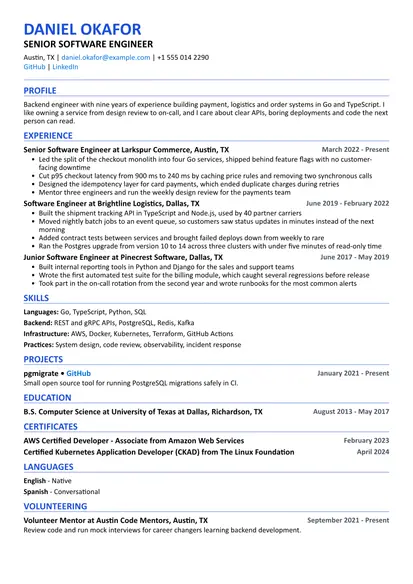
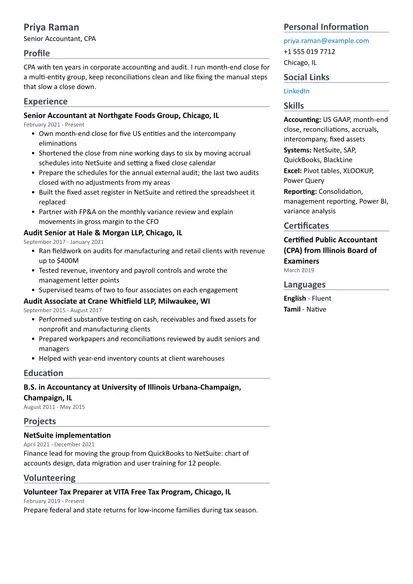
A hiring manager reading a project manager resume wants to see the size of what you ran, how you ran it and how it ended. Budget, team size, timeline and outcome do most of the work. This template uses the Compact layout, so a long career with several projects still fits on one page, and puts certifications right after skills.
The sample belongs to a senior project manager with a PMP who works on software and infrastructure projects. Replace it with your own work and remove the sections you don't need.
Template at a glance
| Setting | This template |
|---|---|
| Layout | Compact, single column |
| Length | One page, two for long careers with many large projects |
| Best for | Project managers, program managers, project coordinators and PMO staff |
| Section order | Summary, experience, skills, certifications, education, languages |
| Also works in | ATS Friendly (plainest for tracking systems), Two Column (when you have many certifications) |
What hiring managers look for
Hiring managers for project roles usually check three things first. Can this person handle a project the size of ours? Have they worked in an industry like ours? Do their projects actually finish?
Scope answers the first question. Budget, team size, number of sites or vendors and length of the project tell the reader what you can handle. Industry answers the second: a hospital IT director wants someone who knows clinical schedules, and a construction firm wants someone who has read a site plan. Outcomes answer the third: delivered on time, under budget, adopted by users, or recovered after a bad start.
Recruiters often read the resume first and match it against the job post. They look for certifications like PMP or PRINCE2, methods like Agile or Scrum, and tools like Jira or MS Project. Make sure the ones you have are written out plainly.
How to write each section
Header and contact details
Your name, the title you are aiming for, city and country, email, phone and a LinkedIn link. If you hold a PMP or another well-known certification, add it after your title, for example "Senior Project Manager, PMP". You don't need a full street address.
Summary
Two or three sentences: your level, the kind of projects you run, their usual size and the industries you know. Write it plainly. Three examples at different levels:
Coordinator or junior: Project coordinator with two years of experience supporting software rollouts for a regional bank. I keep schedules, run status meetings and track risks and actions for projects of 10 to 15 people. Studying for the CAPM.
Project manager: Project manager with six years of experience delivering ERP and warehouse system rollouts for distribution companies. I run projects of 15 to 30 people with budgets up to $2M, and I'm comfortable working between operations teams, IT and vendors.
Senior or program manager: Project manager with ten years of delivering software and infrastructure projects for healthcare and logistics companies. I run projects of 10 to 40 people, keep budgets honest and write status reports that executives actually read.
Certifications
List the full name, the issuing body and the year: "Project Management Professional (PMP), PMI, 2018". The PMP from PMI is the best-known project management certification. PRINCE2 is common in the UK, Europe and Australia. CAPM is an entry-level option from PMI. Scrum certifications like CSM or PSM help for software teams, and SAFe certifications come up in large companies running scaled Agile.
If you are studying for one, you can write "PMP, exam scheduled May 2026". Don't write the letters on their own until you hold the certification.
Experience
List jobs newest first, with the company, your title, the city and dates by month and year. Under each job, describe the main projects you ran, with three to five bullets for recent roles and one to three for older ones. If the company isn't well known, add a short line about what it does and its size.
If you managed many small projects, group them: "Ran 12 to 15 office fit-out projects a year, each $50K to $300K." That is clearer than listing them one by one.
Skills
Group skills into a few labeled lines. The sample uses delivery, control and tools. Delivery covers methods. Control covers budgeting, risk, change and reporting. Tools are the software you plan and track work in. Add a line for industry knowledge if it matters for the roles you want.
Education
Degree, university and years. For most project managers, education sits below experience and needs no detail. A degree in engineering, construction management or business can matter in some industries, so keep the field of study visible. A master's degree or an MBA can go here too.
Writing experience bullets
Write about decisions and results, not ceremonies. Running stand-ups and sending status reports is expected. Choosing to roll out in waves, renegotiating a vendor contract or stopping a project that wasn't going to work are the things that set you apart.
A pattern that works: the project and its size + what you decided or did + how it ended.
- Weak: "Managed the scheduling system project."
- Better: "Led the move of patient scheduling to a new platform across 14 clinics, $3.2M budget, 35 people across IT, operations and the vendor; went live two weeks early."
Use numbers when they are real: budgets, team sizes, number of sites, weeks saved, money saved. If you don't have a number, describe the change in concrete terms, like "the steering meeting format became the PMO standard."
Examples by level
Project coordinator
- Kept the schedule and action log for a 12-person CRM rollout and ran the weekly status meeting
- Tracked vendor invoices against the budget and flagged two overcharges before payment
- Wrote the training plan and booked sessions for 200 users across four offices
- Built a shared project dashboard in Smartsheet that the team used for daily updates
Project manager
- Ran the rollout of a warehouse management system to six distribution centers
- Introduced two-week sprints for the internal development team and a shared backlog in Jira
- Negotiated a change order with the vendor that saved $180K in license fees
- Recovered a project six weeks behind schedule by cutting scope with the sponsor and adding a second test team
Senior project or program manager
- Led the move of patient scheduling to a new platform across 14 clinics: $3.2M budget, 35 people
- Managed a program of five related projects with a combined budget of $8M and reported monthly to the executive team
- Set up a shared risk log and weekly steering meeting that became the standard for the PMO
- Manage three project managers and review their plans, budgets and status reports
Examples by specialty
IT and software
- Delivered the move of 40 internal applications to the cloud over 18 months with no unplanned outages
- Coordinated releases between three development teams and the operations team using a shared release calendar
- Ran user acceptance testing with 25 business users and closed all critical defects before go-live
Construction
- Managed construction of a 60,000 sq ft distribution center, $14M budget, delivered on schedule
- Coordinated eight subcontractors and held weekly site meetings with the client and architect
- Kept change orders under 3% of contract value by resolving design questions before work started
Marketing and agency
- Ran website redesigns for 10 to 12 clients a year, with budgets from $40K to $250K
- Created a standard project brief and kickoff process that cut revision rounds for new projects
- Managed timelines across design, development and copy teams for a product launch in four countries
Healthcare
- Led the rollout of electronic health record updates to three hospitals with clinical staff on every working group
- Scheduled training around nursing shifts so all units were trained before go-live
- Worked with compliance to document privacy requirements before vendor data access was approved
Operations and manufacturing
- Managed the installation of a new packaging line, from vendor selection to full production
- Ran a lean improvement project that removed two manual steps from order processing
- Coordinated the move of production between two plants with no missed customer deliveries
Skills and keywords
Recruiters and tracking systems often search for exact terms, so write them the way job posts do. Only include methods and tools you have used on real projects.
| Category | Common examples |
|---|---|
| Methods | Agile, Scrum, Kanban, Waterfall, hybrid, SAFe, PRINCE2, lean |
| Planning and control | Scope management, scheduling, budgeting, forecasting, risk and issue management, change control |
| People and stakeholders | Stakeholder management, vendor management, steering committees, executive reporting, team leadership |
| Tools | Jira, Confluence, MS Project, Smartsheet, Asana, Monday.com, Excel, Power BI |
| Certifications | PMP, CAPM, PRINCE2, CSM, PSM, SAFe |
| Industry knowledge | Healthcare IT, construction, ERP rollouts, regulated environments, manufacturing |
Soft skills like communication and leadership matter a lot for project managers, but listing them doesn't prove anything. Show them in bullets: running steering meetings, managing other project managers, negotiating with vendors or getting a sponsor to agree to a scope cut.
Tailoring your resume to a job post
Sending the same resume to every opening works less well than a short edit for each one. It takes about ten minutes:
- Read the job post and mark the methods, tools, certifications and project types it repeats.
- Check that the ones you really have appear in your skills and in at least one bullet.
- Move the projects that best match the post to the top of each job.
- Adjust the summary so the first sentence names the kind of project the role is about, for example "ERP rollouts" or "construction projects."
- Make sure the budgets and team sizes you show are close to the scale mentioned in the post, or explain the difference in the summary.
Use the same words as the post when they are true for you. If the post says "stakeholder management" and you ran a steering committee, use both.
Formatting and length
Keep it to one page unless you have a long career with several large projects worth describing. Two pages are fine for senior and program managers. Use one font, a size between 10 and 12 points and the same date format everywhere. Avoid tables, text boxes and images for important information, since some tracking systems skip them.
Send the resume as a PDF unless the employer asks for Word. Name the file clearly, for example "James-Carter-Project-Manager.pdf".
Why the sections are in this order
The template puts experience first, then skills, then certifications, then education. For project managers, what you have delivered matters more than anything else, so it comes first. Skills and certifications follow because recruiters scan for them right after checking your experience.
If you are moving into project management from another job, you might lead with a stronger summary and put certifications higher. People coming from engineering can look at the software engineer template for how to describe technical work, and accountants moving into finance projects can borrow from the accountant template.
Moving into project management
Many project managers start as engineers, analysts, nurses or coordinators. If that's you, pick the parts of your past jobs where you planned, coordinated or delivered something with other people. Describe them with the same scope details: team size, timeline and outcome. A CAPM or a Scrum certification can help show you are serious about the move.
Mistakes to avoid
- Bullets about meetings and status reports with no outcome
- Leaving out budgets and team sizes when you have them
- Claiming every methodology and tool you have heard of
- Long project names that only make sense inside your company
- Taking credit for a whole team's work instead of describing your part
- Writing "PMP" before you hold the certification
- Listing dozens of small projects without grouping them
- Different date formats in different jobs
Checklist before you send it
- Your title and summary match the kind of projects the role is about
- Every recent job has at least one project with its size and outcome
- Certifications show the full name, issuer and year
- The methods and tools from the job post that you know appear on the page
- Numbers are real and consistent across the resume
- The file is a PDF with your name in the file name