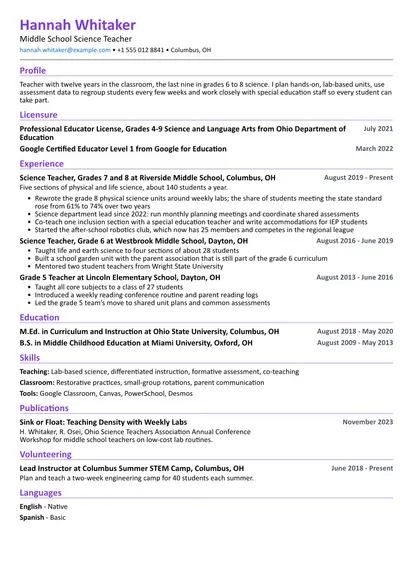
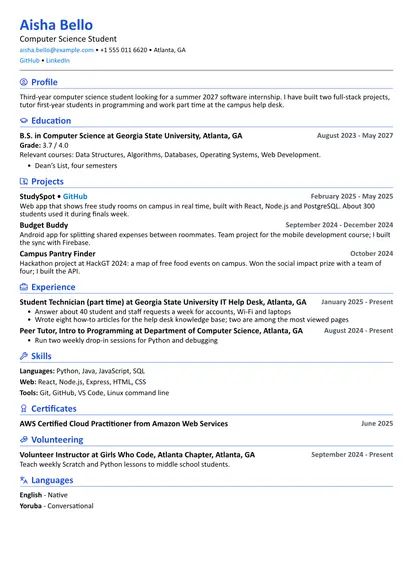
Nurse managers and recruiters read a lot of nursing resumes, and they look for the same things first: your license, your certifications and the kind of units you have worked on. This template puts licenses and certifications right under the summary so nobody has to search for them. It uses the Simple layout, which reads cleanly in the applicant tracking systems many hospital groups use.
The sample belongs to a med-surg nurse with six years as an RN and two earlier years as a patient care technician. Replace it with your own details and delete the sections you don't need.
Template at a glance
| Setting | This template |
|---|---|
| Layout | Simple, single column with dates on the left |
| Length | One page, two for 10+ years or several specialties |
| Best for | Staff nurses, charge nurses, new graduates and travel nurses |
| Section order | Summary, licenses and certifications, experience, education, skills, languages, volunteering |
| Also works in | ATS Friendly (plainest for online applications), Compact (more content on one page) |
What hiring managers look for
A nurse manager reading your resume wants answers to a few practical questions. Are you licensed in this state, or can you be? Which certifications do you hold, and are they current? What kind of patients have you cared for, and at what pace? Can you take a full assignment, precept new staff or cover as charge?
Your resume should answer those questions in the first half of the page. Clinical depth matters more than hospital names. A nurse from a small community hospital who has handled telemetry patients, rapid responses and charge shifts can be a better fit than someone from a large center whose resume only lists duties.
Recruiters often screen first. They match your resume against the job post, so spell out unit types, certifications and systems the same way the post does, for example "Medical-Surgical" or "Med-Surg", "ACLS", "Epic".
How to write each section
Header and contact details
Your name with your credentials, the title you are aiming for, city and state, email and phone. Credentials after your name are common in nursing, for example "Maria Delgado, BSN, RN". Add a LinkedIn link if you keep it up to date. Leave off your full street address, your photo and your date of birth for jobs in the US.
Summary
Two or three sentences: your experience level, the units or patient populations you know and one thing that sets you apart, such as charge experience, a second language or a specialty certification. These examples show the pattern:
New graduate: BSN graduate and newly licensed RN with clinical rotations in med-surg, pediatrics and emergency. Completed a 200-hour preceptorship on a cardiac step-down unit and worked two years as a patient care technician.
Experienced: Registered nurse with six years on busy medical-surgical and telemetry units. Comfortable as charge nurse, calm with deteriorating patients and patient with families who have a lot of questions.
Charge or lead: ICU nurse with ten years of critical care experience and four years as relief charge nurse. Precepted more than a dozen new nurses and led the unit's sepsis bundle compliance work.
Licenses and certifications
For nursing jobs the license is a requirement, not a bonus, so make it easy to find. Write the license type and the state, and add the year you were licensed. If you hold a compact license, say "multistate". Then list your certifications with the issuing body, for example "Basic Life Support (BLS), American Heart Association."
Keep this list current. An expired ACLS card raises a question you don't want in an interview. If a renewal is booked, you can write "renewal scheduled March 2026." This template renames the certificates section to "Licenses & Certifications" so the heading says exactly what it holds.
Experience
List jobs newest first. For each one give the hospital or facility, your title, the unit, the city and the dates by month and year. Then add a short line of context: the number of beds, the typical patient population or your usual ratio. A hiring manager for a step-down unit wants to know quickly whether you have handled telemetry patients before.
Three to five bullets for your current job and one to three for older ones is usually right.
Skills
Group clinical skills separately from systems and leadership. Clinical skills depend on your specialty. Systems are the charting and medication tools you know, such as Epic, Cerner, Meditech or Pyxis. Leadership covers charge, precepting and committee work.
If you speak a second language, list it. Bilingual nurses are in demand in many areas, and it often comes up in interviews.
Education
Degree, school and graduation year. Experienced nurses need nothing more. New graduates can add clinical rotations, a capstone, honors or a GPA if it helps. If you are enrolled in an RN to BSN or MSN program, list it with the expected completion date.
Writing experience bullets
Nursing bullets work best when they show responsibility and judgment. Good material includes charge shifts, precepting, committee work, rapid response calls, patient education, quality projects and any change in how the unit works.
A simple pattern that works: what you did + for whom or how often + what changed.
- Weak: "Administered medications and monitored patients."
- Better: "Cared for five to six telemetry patients per shift, recognized arrhythmias early and escalated to the rapid response team when needed."
Avoid copying your job description. Every RN on the unit administers medications. Write what you did beyond the baseline, or what you did especially often.
Examples by level
New graduate nurse
- Completed a 200-hour preceptorship on a cardiac step-down unit, carrying up to four patients by the final week
- Practiced IV starts, wound care and medication administration across med-surg, pediatric and emergency rotations
- Worked as a patient care technician for two years, assisting with mobility, vital signs and bedside glucose checks
- Created a discharge teaching handout on diabetes management as a capstone project
Experienced staff nurse
- Cared for a 1:5 assignment on a 36-bed med-surg unit with frequent admissions from the emergency department
- Joined the unit falls committee and helped roll out hourly rounding and bed alarm checks
- Taught heart failure patients daily weights, fluid limits and medication timing before discharge
- Super user for the Epic upgrade, trained 30 colleagues on the new medication workflow
Charge nurse or lead
- Charge nurse two shifts a week: assign patients, manage admissions and discharges, and support newer staff
- Precepted eight new graduate nurses through a twelve-week orientation
- Led the unit's sepsis screening audit and presented results at the monthly staff meeting
- Coordinated bed flow with the house supervisor during surge periods
Examples by specialty
Intensive care
- Cared for one to two critically ill patients on ventilators, vasoactive drips and continuous renal replacement therapy
- Managed arterial lines, central lines and sedation protocols
- Responded to code blue events as a member of the hospital code team
Emergency
- Triaged patients using the Emergency Severity Index in a department with high daily volume
- Started IVs, drew labs and prepared patients for imaging and procedures under time pressure
- Cared for trauma, stroke and chest pain patients according to hospital protocols
Pediatrics
- Cared for infants, children and teenagers with respiratory, surgical and oncology diagnoses
- Calculated weight-based medication doses and double-checked them with a second nurse
- Taught parents how to manage feeding tubes and home medications before discharge
Labor and delivery
- Monitored fetal heart rate patterns and recognized changes that needed escalation
- Supported patients through vaginal and cesarean births, including circulating in the operating room
- Started breastfeeding support in the first hour after birth
Med-surg and telemetry
- Cared for post-operative patients after orthopedic, abdominal and urologic surgery
- Interpreted telemetry rhythms and escalated changes to the provider
- Coordinated discharge plans with case managers, physical therapy and families
Operating room
- Worked as scrub and circulating nurse for general, orthopedic and vascular cases
- Completed surgical counts, specimen handling and time-out checks for every case
- Prepared instrument sets and supplies with sterile processing for the next day's schedule
Skills and keywords
Hospital job posts repeat a fairly stable set of terms. Use the ones that are true for you, written the way the post writes them.
| Category | Common examples |
|---|---|
| Licenses | Registered Nurse License, multistate compact license |
| Certifications | BLS, ACLS, PALS, NRP, TNCC, CCRN, CEN, CMSRN, CPN |
| Clinical | Patient assessment, IV therapy, wound care, telemetry, ventilator care, medication administration |
| Patient populations | Adult, geriatric, pediatric, neonatal, post-surgical, oncology, cardiac |
| Systems | Epic, Cerner, Meditech, Pyxis, Omnicell, Alaris pumps |
| Leadership | Charge nurse, preceptor, unit committee, quality improvement |
| Communication | Patient education, family communication, interdisciplinary rounds, handoff |
Soft skills matter a great deal in nursing, but "compassionate" on its own proves nothing. Show them in bullets instead: teaching families, handling a difficult conversation, precepting new nurses or calming a busy shift as charge.
Tailoring your resume to a job post
A few minutes of editing for each application makes your resume a better match:
- Read the post and note the unit type, required certifications, shift and experience level.
- Check that each required certification appears in your licenses section with a current date.
- Move the bullets most related to that unit to the top of each job.
- Adjust your summary so the first sentence names the unit or specialty you are applying to.
- Add any systems the post mentions that you have used, such as Epic or Cerner.
Use the same words as the post when they are accurate. If it says "progressive care" and your unit was called "step-down", you can write "step-down (progressive care)".
Formatting and length
One page is right for most nurses with under ten years of experience. Use one font, a size between 10 and 12 points and consistent month and year dates. Keep important information in normal text, not in images or text boxes, because some tracking systems skip those. This template already follows those rules.
Send the resume as a PDF unless the employer asks for Word. Name the file clearly, for example "Maria-Delgado-RN-Resume.pdf".
Why the sections are in this order
Licenses and certifications come right after the summary because they are the first thing a recruiter checks, and many applications are screened out without them. Experience comes next, because the units you have worked on and the patients you have cared for decide most interviews. Education follows, since the degree matters but rarely changes the decision for experienced nurses.
If you are a new graduate, move education above experience and list clinical rotations there. The student template shows that order for someone early in their career.
Mistakes to avoid
- Burying the license at the bottom of the second page
- Listing duties every nurse on the unit has
- Expired certifications without a renewal date
- Leaving out the unit type, so the reader has to guess what kind of nursing you did
- Patient details, even without names. Keep stories general
- Abbreviations only your hospital uses
- Short travel contracts listed as separate jobs with no explanation
- A two-page resume when one page covers it, especially early in your career
Checklist before you send it
- Your license type and state are near the top, with credentials after your name
- Every certification the post requires is listed and current
- Each job names the unit and gives a line of context
- At least one bullet per recent job shows responsibility beyond the basics
- Systems and languages from the post that you know appear on the page
- The file is a PDF with your name in the file name