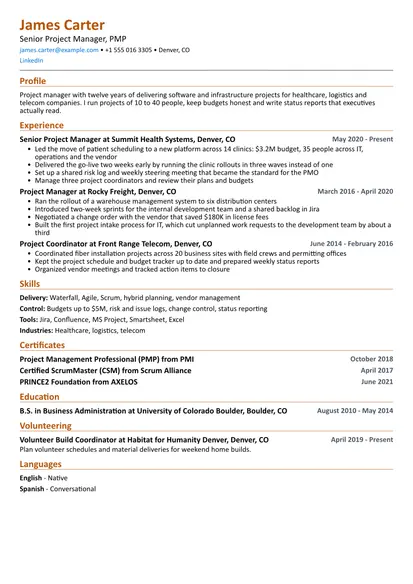
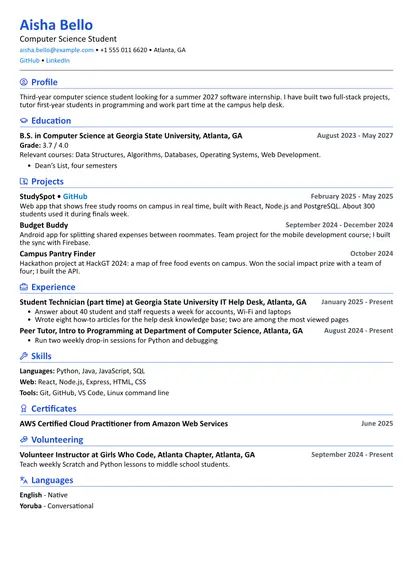
Sales managers hire on evidence. They want to know how much you sold, against what target, to whom and how you found those customers. A sales representative resume that leads with quota attainment, territory size and new business tells them that in seconds. This template uses the Two Column layout: experience and results run down the main column, and skills, CRM tools, certifications and languages sit in the side column where a recruiter can check them at a glance.
The sample belongs to a senior territory sales representative who sells packaging to manufacturers in central Ohio. She started in a phone store, moved to inside sales and then to field sales, which is a common path. Replace her details with your own and delete the sections you don't need.
Template at a glance
| Setting | This template |
|---|---|
| Layout | Two Column, with skills, certifications and languages in the side column |
| Length | One page for almost everyone, two only for long careers with several strong roles |
| Best for | Field sales, inside sales, territory reps, account executives, retail associates moving into B2B |
| Section order | Summary, experience, education, volunteering, then skills, certifications and languages on the side |
| Also works in | ATS Friendly (plainest for large employers with online forms), Compact (when you have many roles) |
What hiring managers look for
A sales manager reading your resume is asking whether you will hit the number they are about to give you. Everything on the page should help answer that.
The first thing they check is attainment. Did you reach quota, and by how much, and for how many years in a row? One great year is good. Three steady years above target is better, because it suggests you can plan a territory and not just get lucky with one big order.
Next they look at the kind of selling you did. Selling a $40 phone plan, a $5,000 office printer contract and a $400,000 supply agreement call for different skills. Deal size, sales cycle length and who you sold to (a store customer, an office manager, a plant director, a purchasing committee) tell them whether your experience fits their product.
Then they look for signs of how you work. Did you find your own customers or work leads handed to you? Do you keep a pipeline and forecast accurately? Did you win back lost accounts or grow existing ones? These details separate a rep who waits for the phone to ring from one who builds a territory.
Recruiters screening for the manager will also match your resume against the job post. They search for the CRM named in the ad, terms like "new business" or "account management," and industry words such as medical devices, SaaS or building materials.
How to write each section
Header and contact details
Your name, the title you are aiming for, your city and state, phone, email and a LinkedIn link. Sales recruiters do check LinkedIn, so make sure your profile matches the resume. If the job is a field role, your city matters, since many companies hire reps who already live in the territory.
Summary
Two or three sentences that give your level, what you sell, to whom, and your best result. Leave out phrases like "results-driven" and "people person." Three examples at different levels:
Entry level or retail: Retail sales associate with two years in a high-traffic electronics store, regularly in the top three of 12 associates for add-on sales. Looking for an inside sales role where I can learn B2B selling.
Inside sales or SDR: Inside sales representative with three years of selling office equipment and service contracts to small businesses by phone and email. I book 14 qualified meetings a month on average and closed $480K in renewals last year.
Field or senior rep: B2B sales representative with ten years in field, inside and retail sales. I manage a 140-account packaging territory, beat quota in each of the last four years and do my best work on plant floors.
Experience
List jobs newest first with the company, your title, city and dates by month and year. If the company is not well known, add a few words about what it sells, for example "regional distributor of dental supplies." Under each job, give three to five bullets for recent roles and one to three for older ones.
Put your strongest numbers in the first two bullets of each job. A manager who reads only those should still know your quota, your attainment and the kind of accounts you handled.
Skills
Group skills into short labeled lines. The sample uses selling, tools, products and other. Selling covers how you work: prospecting, discovery, negotiation, account management. Tools are your CRM and prospecting software. Products show the industry knowledge a new employer won't have to teach you. The last line holds practical details for field jobs, like a driver's license and how much travel you accept.
Certifications and training
Sales has few required certifications, so list only those that a hiring manager in your field will recognize. CRM certifications from Salesforce or HubSpot are useful. Industry credentials matter more in some markets: medical device and pharma reps often need specific training, and some building and insurance roles require a license. Named sales methods such as SPIN, Challenger, MEDDIC or Sandler can go here if your company trained you in them and you use them.
Education
Degree, school and years. For most sales roles a bachelor's degree in any field is enough, and some employers do not ask for one. Keep it short. If you are a recent graduate, the student template shows how to put campus jobs and projects to work instead.
Languages
List languages you can sell in. In many territories a second language widens your customer base, so be honest about the level: native, fluent or conversational.
Writing experience bullets
Good sales bullets have a number, a context and an action. The number is what you achieved. The context is what it was measured against. The action is what you did to get there.
A pattern that works: result + context + how you did it.
- Weak: "Responsible for managing key accounts and driving revenue growth."
- Better: "Grew the top 20 accounts from $1.1M to $1.4M in one year by setting up quarterly reviews with each plant manager."
Avoid repeating the job description. "Prospected new customers" says what the job was. "Opened 23 new accounts in 2025, mostly through plant visits and buyer referrals" says how well you did it.
Keep percentages honest and give the base. "Grew sales 300%" means little if the territory started at $20K. Attainment is usually clearer than growth, because quota already accounts for the size of the territory.
Examples by level
Retail or entry level
- Averaged 18% above store target on accessory sales over 12 months, top three of 11 associates
- Kept a list of 60 repeat customers and called them when new models arrived
- Trained four new hires on the point-of-sale system and the returns process
- Picked as the store's go-to person for small business customers buying five or more phones
Inside sales or SDR
- Made 60 to 80 calls a day and booked an average of 14 qualified meetings a month for field reps
- Converted 22% of inbound leads to opportunities, the highest on a team of nine in 2020
- Closed $480K in renewals and upgrades by calling customers 90 days before contracts ended
- Wrote the email sequence for lapsed customers that the whole team now uses
Field or senior sales representative
- Reached 112% of a $1.6M quota in 2024 and 118% in 2025, second of 14 reps in the region
- Opened 23 new accounts in one year with an average first-year order of $38K
- Won back a lapsed $210K a year account after running a trial on their packing line
- Keep a 3x pipeline in Salesforce and forecast within 5% of actual for six quarters in a row
- Mentor two new reps during their first 90 days, including joint visits to key accounts
Examples by specialty
Industrial and distribution
- Sold fasteners and MRO supplies to 90 manufacturers in a two-county territory, quota $2.2M
- Set up vendor managed inventory at six plants, which turned one-off orders into monthly contracts
- Worked with the warehouse team to cut delivery times for the top 15 customers from five days to two
Medical devices and healthcare
- Covered 45 clinics and two surgery centers for wound care products, 106% of quota in 2025
- Ran in-service training for nursing staff at each new account before the first order shipped
- Got a new product line approved by a hospital value analysis committee after a three-month trial
Software and SaaS
- Closed $620K in new annual recurring revenue in 2025 selling to mid-market finance teams
- Ran demos and trials for deals averaging $28K a year with a 70-day sales cycle
- Worked with customer success on renewals and expansions in my book of 40 accounts
Consumer goods and route sales
- Managed 180 grocery and convenience stores on a weekly route, with shelf space and promotions in every visit
- Got the new snack line into 120 stores within eight weeks of launch
- Kept out-of-stocks under 3% by checking shelves and placing orders on every visit
Retail and direct to consumer
- Sold furniture and mattresses with an average ticket of $1,900, top seller in the store for 2024
- Followed up with every customer within a week of delivery, which brought in steady referrals
- Raised protection plan attachment from 25% to 38% across the store by coaching new staff
Skills and keywords
Write skills the way job posts write them, and only include the ones you use. Tracking systems and recruiters often search for exact terms like "Salesforce" or "new business development."
| Category | Common examples |
|---|---|
| Selling | Prospecting, cold calling, discovery, solution selling, negotiation, closing, account management, upselling |
| Pipeline and planning | Territory planning, pipeline management, forecasting, quota attainment, account plans |
| Tools | Salesforce, HubSpot, Microsoft Dynamics, LinkedIn Sales Navigator, Outreach, Salesloft, ZoomInfo, Excel |
| Methods | SPIN Selling, Challenger, MEDDIC, Sandler, consultative selling |
| Sales types | B2B, B2C, inside sales, field sales, key accounts, channel sales, route sales |
| Practical | Driver's license, travel percentage, second language |
Soft skills like persuasion, resilience and relationship building matter in sales, but writing them down proves little. Bullets do that better: a won-back account shows persistence, a referral stream shows relationships, a long run above quota shows discipline.
Tailoring your resume to a job post
A short edit for each application works better than one resume for everything. It takes about ten minutes:
- Mark what the post repeats: new business or account management, field or inside, the industry, deal size and the CRM.
- Make sure the matching facts from your history appear in your summary and in the first bullets of each job.
- If the post is about hunting new customers, lead with new accounts opened. If it is about growing existing accounts, lead with retention and growth in your book.
- Put the CRM they name into your skills if you have used it. If you used a similar one, list yours; managers know the tools are close.
- For a field role, check that your city is visible and that your travel line matches what they ask.
Use their words when they are true for you. If the post says "account executive" and your title was "territory representative" doing the same work, you can mention both in your summary.
Formatting and length
Keep it to one page. Sales managers often read a resume in under a minute and look for numbers, so give them room. Use one font, a size between 10 and 12 points and the same date format throughout. Bold is fine for a job title, but don't bold every number; it makes the page harder to read.
Send a PDF unless the employer asks for Word, and name it clearly, for example "Megan-Ortiz-Sales-Representative.pdf". If you apply through a large company's online form, the ATS Friendly layout is the safest choice.
Why the sections are in this order
The summary comes first because it gives the reader your level and best number before they reach the details. Experience follows, since sales results are the main reason anyone will call you. Education sits below experience because, for most sales roles, it is a box to tick rather than a deciding factor.
The side column holds skills, certifications and languages. These are things a recruiter checks quickly, often against a list, so keeping them apart from the main story makes that check fast. If you are applying for your first sales job, you might move education up and add a short projects section. Reps moving into sales operations or account management of large rollouts can borrow from the project manager template, which shows how to describe scope, timelines and stakeholders.
Mistakes to avoid
- Bullets that describe duties instead of results
- Percentages with no base, such as growth figures without a starting amount
- Leaving out quota and attainment when you have them
- Claiming every sales method and CRM you have heard of
- Revenue numbers that don't match between the summary and the bullets
- Naming customers whose details are confidential
- Missing the year next to a ranking or award
- Hiding a field location or travel limit that the employer will find out anyway
Checklist before you send it
- Your title and summary match the type of sales in the job post
- Every recent job has at least one number tied to a target or ranking
- Quota, attainment and deal sizes are honest and consistent
- The CRM and industry terms from the post that you know appear on the page
- Your city and travel availability are clear for field roles
- The file is a PDF with your name in the file name