A receptionist is the first person a visitor, patient or guest meets, and the person who keeps the phones, the calendar and the waiting room under control. Office managers who hire for this role want to know three things quickly: what kind of front desk you have run, which systems you use, and how you treat people when the day gets busy. This template answers those in the first half of the page.
The sample belongs to a front desk coordinator at a family medicine clinic who previously worked at a hotel and a small law office. That mix is common, and it shows how to describe each setting so a reader sees the skills that carry over. The Simple layout keeps everything in one clean column that reads well on paper and in online application systems.
Template at a glance
| Setting | This template |
|---|---|
| Layout | Simple, single column |
| Length | One page |
| Best for | Office receptionists, medical and dental receptionists, hotel front desk agents, front desk coordinators, administrative assistants who cover reception |
| Section order | Summary, experience, skills, languages, education, certifications |
| Also works in | ATS Friendly (large employers with online portals), Compact (if you have many short jobs to fit) |
What hiring managers look for
The person hiring a receptionist is usually an office manager, a practice manager or a front office supervisor. They are not looking for an impressive title. They want someone who shows up on time, answers the phone the same way at 4:55 as at 9:00, and does not lose track of who is waiting.
When they read your resume, they look for volume and setting. How many calls a day? How many providers or rooms did you schedule for? How many guests checked in on a busy night? A front desk at a twelve-provider clinic is a different job from a front desk at a quiet architecture firm, and a manager wants to see that you have handled something close to their own workload.
They also look for the systems they already use. A dental practice on Dentrix, a hotel on Opera, a clinic on Epic: if you name the same software, you need less training, and that matters in a role where the person often starts covering the desk alone within a week or two.
Finally, they read between the lines for reliability and judgment. Did you stay at jobs for a reasonable time? Were you trusted with cash, keys, petty cash or confidential files? Did anyone ask you to train the next person? Those details say more than any list of personal qualities.
How to write each section
Header and contact details
Your name, the job title you want, your city and state, a phone number and a professional email. Make sure your voicemail greeting is clear and has your name in it, because a hiring manager for a phone-heavy role will notice. A LinkedIn link is fine if your profile is current. You don't need a street address.
Use the title from the posting when it fits you: "Medical Receptionist", "Front Desk Agent", "Front Desk Coordinator" or "Receptionist and Office Assistant".
Summary
Two or three sentences: what kind of front desk you know, how long you have worked in it, and what you handle beyond greeting visitors. Here is how it changes at different stages:
Entry level: Friendly and organized customer service worker with two years at a busy pharmacy counter. Comfortable on a multi-line phone, quick with Microsoft Office and fluent in Spanish. Looking for my first full-time front desk role in a clinic or office.
Experienced receptionist: Receptionist with six years in professional offices, most recently a 40-person engineering firm. I run the visitor desk and main phone line, book conference rooms, order supplies and keep the lobby ready for client meetings.
Front desk lead: Front desk coordinator with eight years in hotels and outpatient clinics. I run check-in for a twelve-provider practice, train new front desk staff and handle insurance questions before they turn into billing problems.
Experience
List jobs newest first with the employer, your title, the city and the dates. Then add one short line of context that sets the scale: the type of business, the number of providers, staff or rooms, and the call or visitor volume if you know it roughly.
Write three to five bullets for your current job and two or three for older ones. Each bullet should show something you handled, organized or improved. Avoid bullets that only restate the job title, like "answered phones" or "greeted visitors". Everyone who reads the resume knows a receptionist does that. Tell them how many, for whom, and what went better because of you.
Skills
Group skills into short labeled lines. The sample uses three: front desk skills, scheduling and records, and software. Name the actual tools (Epic, Dentrix, Opera PMS, Microsoft 365, RingCentral) rather than writing "computer skills".
Languages
Give this its own section. Clinics, hotels and city offices often post jobs that say "bilingual preferred" or pay more for a second language. Use clear levels like native, fluent, conversational or basic, and be honest: you may be asked to take a call in that language during the interview.
Education
List your highest diploma or degree with the school and the year. An associate degree or a certificate program in medical office administration, hospitality or business goes here. If you finished high school recently and have no degree, list the diploma and any relevant courses.
Certifications
Optional, but useful. A medical administrative assistant credential, CPR training, a notary commission or a Microsoft Office certificate can each help in the right office. List the name, who issued it and the year.
Writing experience bullets
A good receptionist bullet answers three questions: what you handled, how much of it, and what difference it made. A simple pattern: task + scale + result.
- Weak: "Answered phones and scheduled appointments."
- Better: "Answer the main line for a six-provider clinic, about 120 calls a day, and book same-day sick visits so patients are seen before noon when possible."
When you don't have numbers, use comparisons and specifics. "Set up a shared calendar for three conference rooms, which ended double bookings" is concrete even without a figure.
Examples by level
Entry level or first front desk job
- Greeted and checked in about 60 customers a day at a pharmacy pickup counter
- Answered a four-line phone, transferred calls and took clear messages for the pharmacists
- Balanced the register at the end of every shift with no shortages over 18 months
- Trained two new seasonal hires on the counter routine and phone scripts
Experienced receptionist
- Run the reception desk for a 40-person office: visitors, deliveries, the main phone line and the shared inbox
- Book and prepare four meeting rooms, including catering orders for client meetings
- Created a visitor sign-in process with badges and host notifications, so nobody waits in the lobby unannounced
- Order office and kitchen supplies within a monthly budget and track spending in a shared spreadsheet
Front desk lead or coordinator
- Lead a front desk team of four: build the weekly schedule and cover breaks during peak hours
- Wrote a one-page guide for new hires covering check-in, insurance verification and phone etiquette
- Reduced the number of patients arriving without an insurance check by calling every new patient two days before the visit
- Handle escalated complaints at the desk and pass patterns on to the practice manager every month
Examples by setting
Medical or dental office
- Check in 70 to 90 patients a day, scan IDs and insurance cards, and collect copays
- Verify insurance eligibility before visits and flag coverage problems to the billing team
- Schedule appointments across five providers in Epic, including recall and follow-up visits
- Keep patient information private at the desk and on the phone, following HIPAA rules
Hotel or hospitality
- Checked in and out up to 150 guests a shift at a 180-room hotel using Opera PMS
- Handled room changes, late checkouts and billing questions at the desk and by phone
- Balanced the shift cash drawer and processed card payments and deposits
- Recommended local restaurants and tours and arranged airport transport for guests
Law firm or professional office
- Greet clients, offer refreshments and let attorneys know when their visitors arrive
- Route calls for twelve attorneys and keep accurate messages when they are in court
- Log incoming mail and courier deliveries and track documents that need signatures
- Keep the lobby and conference rooms ready for confidential meetings
Corporate lobby or building
- Register up to 200 visitors a day and issue temporary access badges
- Coordinate with building security on deliveries, contractors and after-hours guests
- Maintain the emergency contact list and help run fire drill check-ins for the floor
Salon, spa or fitness center
- Book appointments for eight stylists and keep the daily schedule full by working the waitlist
- Sell memberships and retail products at the desk and process payments
- Called clients the day before their appointment, which cut no-shows noticeably
Skills and keywords
Front desk job posts tend to repeat the same terms, and online application systems often look for them. Use the wording from the posting, and only list what you actually do.
| Category | Common examples |
|---|---|
| Front desk | Greeting visitors, multi-line phones, call routing, visitor management, mail and deliveries |
| Scheduling | Appointment scheduling, calendar management, meeting room booking, waitlists, reminders |
| Patient or guest services | Check-in and check-out, insurance verification, copays, reservations, complaint handling |
| Office support | Data entry, filing, supply ordering, petty cash, document scanning |
| Software | Microsoft 365, Google Workspace, Epic, eClinicalWorks, Dentrix, Opera PMS, RingCentral |
| Communication | Bilingual service, phone etiquette, written messages, de-escalation |
"Excellent communication skills" and "people person" appear on almost every receptionist resume, so they don't help you stand out. Show those qualities in your bullets instead: the angry caller you calmed down, the new system you explained to older patients, the visitor log you made easier to use.
Tailoring your resume to a job post
Front desk jobs vary a lot, so ten minutes of editing for each application pays off:
- Read the posting and mark the setting (clinic, hotel, office), the software named and any skills mentioned twice.
- Change the title under your name to match the posting, as long as it is honest.
- Move the bullets closest to that setting to the top of each job. For a clinic, put insurance and scheduling first. For a hotel, put check-in volume and cash handling first.
- Rewrite the first sentence of your summary so it names the type of front desk the employer runs.
- If the posting asks for a language, a typing speed or a specific system, make sure the answer is easy to find.
Use the employer's terms when they describe what you did. If the post says "patient registration" and you checked in patients, write "patient registration".
Formatting and length
Keep it to one page. A receptionist resume that runs over is a small warning sign in a job that is about being organized. Use one font at 10 to 12 points, the same date format everywhere and plenty of white space between jobs.
Avoid headers, text boxes and graphics for important details, because some application systems skip them. Save the file as a PDF unless the employer asks for Word, and name it clearly, for example "Danielle-Ortiz-Front-Desk-Coordinator.pdf". Check spelling twice. A typo on a receptionist resume suggests typos in the messages you will take.
Why the sections are in this order
Experience comes right after the summary because the front desk is a hands-on job, and managers want to see where you have worked and at what pace before anything else. Skills follow so the systems you use sit close to the jobs where you used them.
Languages come next and get their own heading. In many front desk roles a second language is a deciding factor, not an extra, so it should not be buried at the bottom.
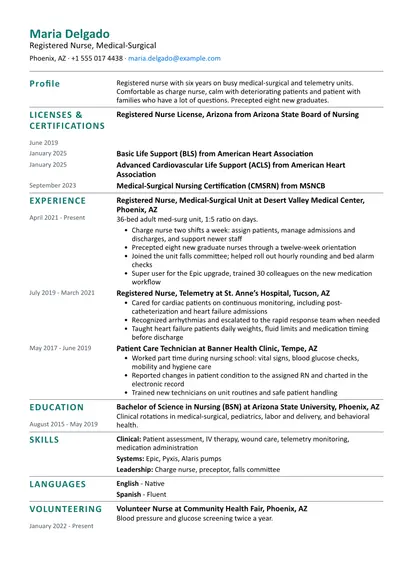
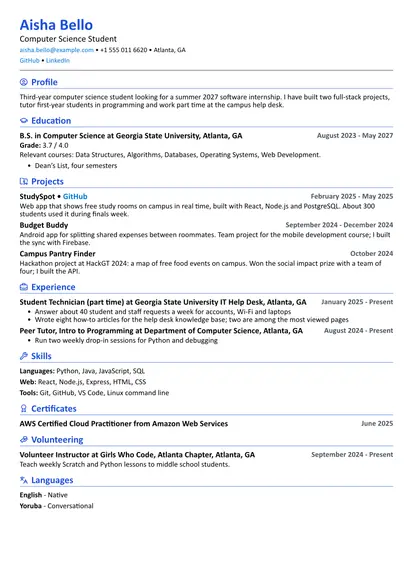
Education and certifications close the page. They matter, especially for medical offices, but rarely decide an interview on their own. If you are applying for your first job and have more training than experience, the student template puts education first. For clinic front desk roles, the registered nurse template is also worth a look to see how healthcare employers describe units, systems and patient volume.
Mistakes to avoid
- Bullets that only say "answered phones" and "greeted visitors" with no scale or setting
- Writing "computer literate" instead of naming the software
- Leaving out a second language because you think it is not relevant
- Personal qualities like "bubbly" or "hard-working" with nothing to back them up
- Including patient, client or guest names in your examples
- Unexplained gaps or a long list of very short jobs without context
- A resume longer than one page
- Spelling mistakes or inconsistent dates, which undercut a job built on accuracy
Checklist before you send it
- The title and summary name the type of front desk in the posting
- Every recent job has a line that shows the setting and the volume
- The software the employer uses appears on the page if you know it
- Languages are listed with honest levels
- No names or private details of patients, clients or guests
- Dates, phone number and email are correct and consistent
- The file is a one-page PDF with your name in the file name