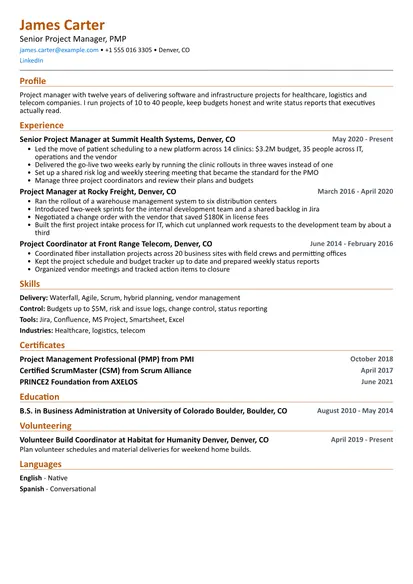
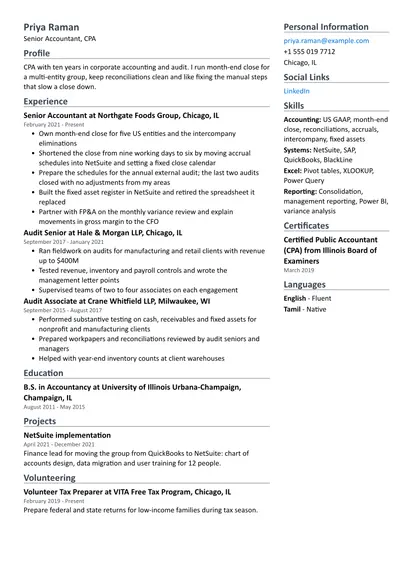
Hiring for a marketing manager comes down to one question: when this person spends money and time, does the business get something back? Your resume should answer it with budgets, channels, team size and results that a sales or finance leader would recognize. This template uses the Two Column layout. Experience fills the main column, and the side column holds skills, tools, certifications and languages, which marketing recruiters scan for early.
The sample belongs to a senior marketing manager who has worked in B2B software and in direct-to-consumer retail. Swap in your own campaigns and numbers and delete the sections you don't use.
Template at a glance
| Setting | This template |
|---|---|
| Layout | Two Column, with skills, tools and certifications in the side column |
| Length | One page, two for heads of marketing and directors |
| Best for | Marketing managers, digital and growth marketers, brand managers, content and lifecycle leads |
| Section order | Summary, experience, education, then skills, certifications and languages on the side |
| Also works in | ATS Friendly (for large employers with strict screening), Compact (for long careers with many roles) |
What hiring managers look for
Most marketing leaders read a resume looking for three signals. The first is commercial thinking: do you talk about pipeline, revenue, retention and cost, or only about impressions and likes? The second is range: have you planned a campaign from the brief to the report, worked across channels and managed people or agencies? The third is fit: have you sold to the same kind of customer, through the same kind of funnel, at a similar budget?
A marketer who has run paid search for an online store and one who has built an account-based program for enterprise software both hold the title "marketing manager", but the jobs are very different. Say early which world you come from. Your summary and the first bullet of each job should make the customer type, the channels and the budget obvious.
Recruiters often screen before the hiring manager sees anything. They search for tools like HubSpot, Salesforce, Google Ads and GA4, for channels like SEO, paid social or email, and for words from the job title such as "demand generation" or "brand". Use the exact names for the ones you know.
How to write each section
Header and contact details
Your name, the title you want, your city, email, phone and LinkedIn. Add a portfolio or personal site if it shows real campaigns. A title line like "Senior Marketing Manager, B2B SaaS" or "Brand Manager, Consumer Goods" tells a recruiter in two seconds where you fit. Skip the full street address and the photo for jobs in the US, the UK and Canada.
Summary
Two or three sentences about your level, the markets you know, the channels you run and the scale of your work. Avoid words like "passionate" or "creative storyteller" that every applicant uses. Here is how it looks at three levels:
Coordinator or specialist: Marketing specialist with three years running email and paid social for a regional fitness chain. I plan monthly campaigns, build landing pages in HubSpot and report weekly on cost per signup. Google Ads and HubSpot certified.
Marketing manager: Marketing manager with six years in B2B software. I own demand generation for a mid-market product, manage a $900K annual program budget and work closely with sales on lead quality and handoff.
Senior manager or head of marketing: Marketing leader with ten years across B2B software and consumer retail. I build small teams, set the channel mix and budget, and report revenue impact to the executive team each quarter.
Experience
List roles newest first with the company, your title, city and month and year. Start each role with the scope: budget, team, channels and markets. Then add three to five bullets about campaigns or changes you led, each with a result. Older roles need one to three bullets.
If the company is not well known, add a short description line, for example "Outdoor gear retailer, 40 stores and an online shop." That tells the reader the size of the audience and the kind of marketing you did without a long explanation.
Skills
The side column is narrow, so keep each line short and grouped. The sample uses four groups: channels, strategy, tools and analytics. Channels are what you buy and run. Strategy covers positioning, planning and launches. Tools are the platforms you work in every week. Analytics covers how you measure. Put the items that match the job post first.
Certifications
Name the certificate, the issuer and the year, for example "Google Ads Search Certification, Google, 2025". Platform certificates from Google, Meta, HubSpot, LinkedIn or Salesforce show tool knowledge. A broader course in digital marketing or a professional diploma can help when you are early in your career. Remove certificates that have expired or no longer match the work you want.
Education
Degree, school and years. A degree in marketing, communications, business or economics is common, but many good marketers come from journalism, psychology or design. Keep the field of study visible and add an MBA here if you have one. Leave out grades unless you graduated in the last two or three years.
Writing experience bullets
Write about what changed because of your work. Running the social calendar or sending the newsletter is expected. Moving budget from a weak channel to a stronger one, fixing the handoff between marketing and sales, or launching a product into a new market is what a hiring manager remembers.
A pattern that works: the goal or problem + what you decided or built + the result in business terms.
- Weak: "Responsible for paid social campaigns."
- Better: "Rebuilt paid social targeting around past buyers and lookalikes, cutting cost per first order from $41 to $28 while monthly spend stayed flat."
Use numbers you can defend in an interview: budget, revenue, pipeline, cost per lead or order, conversion rate, retention or team size. Say what the number measures. "Increased engagement by 300%" means little; "tripled replies to the onboarding email series" means something.
Examples by level
Marketing coordinator or specialist
- Built and sent 6 to 8 email campaigns a month to a list of 120,000 subscribers, with A/B tests on every subject line
- Managed the content calendar for three social channels and coordinated posts with the sales team for each product drop
- Set up conversion tracking in GA4 and Google Tag Manager so paid campaigns could be compared on cost per signup
- Produced the weekly channel report that the marketing manager used to move budget between campaigns
Marketing manager
- Own demand generation for the mid-market product line with a $900K annual budget across paid search, LinkedIn, events and webinars
- Launched a webinar series with the product team that became the largest source of sales-accepted leads within two quarters
- Agreed a lead scoring model with sales leadership, which cut the share of leads returned as unqualified by about half
- Manage two specialists and an external paid media agency, with monthly reviews against cost per opportunity
Senior marketing manager or head of marketing
- Set the annual marketing plan and $2.4M budget for a retail brand with 40 stores and an online shop
- Moved a third of the print budget into paid social and email, and online revenue grew 38% over two years with no increase in total spend
- Built a team of five covering performance, content, CRM and design, hiring three of them
- Present marketing results and the next quarter's plan to the executive team and the board
Examples by specialty
Performance and paid media
- Restructured Google Ads accounts by margin band instead of product category, raising return on ad spend while keeping volume
- Ran incrementality tests with geo holdouts before increasing spend on paid social
- Cut wasted search spend by building negative keyword lists from three months of search term reports
Brand and product marketing
- Led the repositioning of a 20-year-old household brand, from customer research with an agency to new packaging in 2,000 stores
- Wrote the launch plan, messaging and sales enablement kit for a new product tier sold through partners
- Ran quarterly brand tracking with a research partner and used the results to adjust the media plan
Content and SEO
- Built a content program of two long guides a month that became the top source of organic signups
- Fixed technical SEO issues with the web team, including redirects and page speed, after a site migration
- Set up an editorial process with subject matter experts so articles were reviewed before publishing
Lifecycle and CRM
- Rebuilt the onboarding email series based on product usage, which improved trial to paid conversion
- Introduced a win-back program for lapsed customers with a tested offer ladder
- Cleaned and segmented a CRM database of 300,000 contacts and set rules for consent and suppression
Events and field marketing
- Planned the company's presence at four trade shows a year, with booth, meetings and follow-up sequences
- Ran regional customer dinners with the sales team and tracked the pipeline they influenced
- Cut event costs by negotiating multi-year booth packages and reusing stand materials
Skills and keywords
Tracking systems and recruiters often look for exact terms, so write them the way job posts do. Only include channels and tools you have used on real campaigns.
| Category | Common examples |
|---|---|
| Channels | SEO, paid search, paid social, email, content, events, partnerships, influencer, affiliate |
| Strategy | Go-to-market, positioning, messaging, segmentation, campaign planning, product launches, pricing input |
| Demand and growth | Demand generation, lead scoring, account-based marketing, conversion rate optimization, funnel analysis |
| Tools | HubSpot, Salesforce, Marketo, Google Ads, Meta Ads Manager, LinkedIn Campaign Manager, Semrush, Canva, Figma |
| Analytics | GA4, Google Tag Manager, Looker Studio, Excel, attribution, A/B testing, cohort analysis |
| Certifications | Google Ads, Google Analytics, Meta Blueprint, HubSpot Inbound, LinkedIn Marketing Labs |
Creativity, communication and leadership matter in marketing, but writing them in a list doesn't prove them. Show them in bullets instead: a campaign idea that worked, a brief you wrote for an agency, a team you hired or a plan you sold to a skeptical sales director.
Tailoring your resume to a job post
A general resume reads like a general marketer. Spend ten minutes fitting it to each post:
- Read the post twice and mark the channels, tools, customer type and goals it mentions more than once.
- Make sure the channels and tools you really use appear in the side column and in at least one bullet.
- Reorder the bullets in each job so the work closest to the post comes first.
- Rewrite the first line of your summary to match the role, for example "demand generation for B2B software" or "brand marketing for consumer goods."
- Check that your budgets and team sizes are in the same range as the role. If the new job is much bigger, show the fastest growth you have handled.
Use the post's words when they are true. If it says "lifecycle marketing" and you ran onboarding and retention emails, say lifecycle marketing.
Formatting and length
One page is right for most marketing managers. Two pages are fine for directors and heads of marketing with large budgets and several employers. Use one font, keep the size between 10 and 12 points and pick a single accent color. Put important text in normal paragraphs and bullets, not in images, icons or charts, because some screening systems read only plain text.
Send a PDF unless the post asks for Word, and name it clearly, for example "Megan-Torres-Marketing-Manager.pdf". If you link to a portfolio, check that it opens without a login.
Why the sections are in this order
Experience leads because results from past campaigns are the strongest evidence a marketer has. Education follows in the main column and is short for most people. Skills, tools, certifications and languages go in the side column, where a recruiter checking for "HubSpot" or "GA4" can find them without reading every bullet.
If you are early in your career, you can move education higher and add a project section for a campaign you ran at university or for a club. Students can borrow ideas from the student template. If much of your job is planning launches and coordinating teams, the project manager template shows how to describe scope and delivery.
Moving into marketing management
Many marketing managers start in sales, customer success, journalism, design or analytics. If that's you, pull out the parts of your past work that look like marketing: writing customer emails, building a sales deck, running a small budget, analyzing customer data or launching something with other teams. Describe them with the same details a marketer would use, such as audience, channel, budget and result. A short platform certificate and one campaign you ran yourself, even for a small business or a nonprofit, make the move easier to believe.
Mistakes to avoid
- Listing tasks like "managed social media" with no audience, budget or result
- Reporting only vanity metrics such as impressions or followers
- Claiming a revenue number without saying how marketing contributed to it
- Long lists of tools you opened once
- Buzzwords like "growth hacker", "guru" or "ninja" in your title
- Heavy design, icons or charts that tracking systems can't read
- A portfolio link that is broken or asks for a password
- Different date formats or currencies in different jobs
Checklist before you send it
- Your title and summary name the customer type and the channels the role is about
- Each recent job shows the budget, team or channel scope you handled
- At least one bullet per job ties your work to pipeline, revenue, retention or cost
- Tools and channels from the post that you know appear in the side column
- Numbers are real, consistent and explained
- The file is a PDF with your name in the file name, and any links open