Customer service hiring moves fast. A recruiter for a contact center may have forty open seats and several hundred applications, so they read for a few things only: the channels you have worked, the systems you know, the numbers you hit and the languages you speak. This template puts those details where a quick reader expects them. It uses the ATS Friendly layout because most support jobs are posted through large applicant tracking systems that read plain, single column files best.
The sample belongs to a customer service representative with five years of experience, starting in a grocery store and moving into phone and chat support for an internet provider. Swap in your own details and remove anything you don't need.
Template at a glance
| Setting | This template |
|---|---|
| Layout | ATS Friendly, single column with plain headings |
| Length | One page |
| Best for | Call center agents, chat and email support, retail service desks, help desk tier 1, team leads |
| Section order | Summary, experience, skills, education, languages, certifications, volunteering |
| Also works in | Simple (a little more white space), Compact (more lines on one page) |
What hiring managers look for
A support team lead reading your resume is trying to predict how you will perform on the floor. They want to know whether you can handle the volume, whether customers come away happy and whether you will show up for your shifts. They also want to know how long it will take to train you, which depends on the tools and channels you already know.
That means context matters more than job titles. "Customer Service Representative" can describe someone who answers twenty friendly calls a day or someone who handles back to back billing complaints. Tell the reader which one you were. Mention the channel, the type of customer, the typical volume and the kind of problems you solved.
Numbers carry weight here because contact centers measure almost everything. If you know your satisfaction score, quality score, first contact resolution or average handle time, and they compare well with your team, use them. If you don't have exact numbers, describe the volume instead: calls per shift, tickets per day, customers per hour at the register.
Reliability is the quiet requirement. Schedule adherence, attendance awards and being trusted to cover peak periods all tell a manager that you are someone they can plan around.
How to write each section
Header and contact details
Your name, the job title you want, your city and state, a phone number and an email address you check daily. Recruiters for hourly support roles often call or text within a day or two of an application, so make sure your voicemail is set up and sounds professional. Add a LinkedIn link if it is current. Leave off your street address, your photo and your date of birth.
If you only want remote work, write "Remote" next to your city or in the title line, for example "Customer Service Representative, Remote".
Summary
Two or three sentences: how long you have worked in service, the channels and industries you know, and one detail that makes you stand out, such as a second language, a strong quality score or experience training new hires. Some patterns that work:
Entry level: Friendly and dependable cashier with two years of retail experience, used to busy weekend shifts and handling returns at the service desk. Looking for a first role in phone or chat support.
Experienced: Customer service representative with five years in phone and chat support for an internet provider. Resolve billing and connection issues on the first contact most of the time and keep customers calm when they call in frustrated. Bilingual in English and Spanish.
Team lead: Support team lead with eight years in contact centers, the last three supervising a team of twelve agents. Run daily huddles, coach on quality reviews and handle escalated calls.
Experience
List jobs newest first. For each one give the company, your title, the city (or "Remote") and the dates by month and year. Add a one line description if the company name doesn't explain the work, for example "Inbound phone and chat support for residential internet customers."
Then write three to five bullets for your current job and one to three for older ones. Good material includes the volume you handled, the problems you solved, the metrics you hit, any extra responsibility (mentoring, escalations, quality checks) and any process you helped improve.
Skills
Split skills into small groups so a recruiter can scan them:
- Channels: phone, live chat, email, social media, in person
- Systems: the CRM and ticketing tools you have used, the phone system, the point of sale, any billing or order system
- Other: typing speed, data entry, knowledge base writing, basic troubleshooting
Write each tool's name the way the vendor writes it: "Zendesk", "Salesforce Service Cloud", "Freshdesk", "Five9". Those exact words are what tracking systems search for.
Languages
If you can support customers in more than one language, give this its own section and state your level honestly. Many contact centers pay a bilingual differential and hire specifically for language queues, so this can be the line that gets you the interview.
Education and certifications
Your highest diploma or degree, the school and the year. High school or GED is completely fine for most support roles. Certifications are optional, but short courses in customer service, a vendor certificate like Zendesk or HubSpot, or a CompTIA A+ for technical support can help.
Writing experience bullets
Service bullets work best when they show what kind of customer contact you handled and how well. A pattern that holds up: what you handled + how much or how often + the result.
- Weak: "Answered customer calls and resolved issues."
- Better: "Handled 60 to 70 inbound calls per shift on billing, outages and plan changes, with a first contact resolution rate of 81%."
Avoid copying the job posting from your last employer. Everyone on the floor answered calls. Write what you did well, what you did often or what you were trusted with.
Examples by level
Entry level or first support role
- Served 150 or more customers per shift at a busy grocery register, including weekend and holiday rushes
- Processed returns and exchanges at the service desk and explained store policy to upset customers without calling a manager
- Answered product questions by phone and placed special orders for customers
- Recognized twice by store management for positive customer comments
Experienced representative
- Resolved billing, connection and equipment questions over phone and chat for residential internet customers
- Kept a quality score above 95% for six consecutive quarters on monthly call reviews
- Handled up to three chats at once while meeting the team target for response time
- Reduced repeat contacts by writing clear follow up notes and setting expectations on callback times
Senior representative or team lead
- Supervised a team of twelve agents on the evening shift, covering scheduling, breaks and real time queue management
- Coached agents after quality reviews, focusing on call control and accurate notes
- Took escalated calls from customers who asked for a supervisor and resolved most without a credit
- Trained 25 new hires through a four week onboarding program
Examples by specialty
Inbound call center
- Answered calls for a utility company on start, stop and transfer of service, outages and payment plans
- Met schedule adherence targets every month and covered extra shifts during storm related call spikes
- De-escalated frustrated callers and documented each interaction in the CRM
Chat and email support
- Handled up to four live chats at once for an online clothing retailer
- Wrote email replies using saved responses and personal edits so customers never received a generic answer
- Flagged recurring questions to the knowledge base team, which led to four new help articles
Retail service desk
- Managed the customer service desk at a home improvement store: returns, special orders, layaway and price checks
- Settled disputes over receipts and warranties within store policy
- Trained seasonal staff on the register and return procedures
Technical support and help desk
- Walked customers through router resets, Wi-Fi setup and account login problems over the phone
- Escalated hardware faults to tier 2 with complete notes, which cut back and forth with the engineering team
- Logged and tracked tickets in Jira Service Management and closed them within agreed response times
Billing and collections
- Explained invoices, late fees and payment options to residential and small business customers
- Set up payment arrangements in line with company policy and followed up on missed payments
- Processed refunds and adjustments with a high accuracy rate on monthly audits
Travel and hospitality
- Rebooked passengers during flight delays and cancellations, often under time pressure
- Handled loyalty program questions, seat changes and baggage claims by phone
- Supported guests in English and French during peak summer season
Skills and keywords
Support job posts use a fairly small set of terms. Use the ones that are true for you, spelled the way the post spells them.
| Category | Common examples |
|---|---|
| Channels | Inbound calls, outbound calls, live chat, email support, social media support, omnichannel |
| CRM and ticketing | Zendesk, Salesforce Service Cloud, Freshdesk, HubSpot Service Hub, Zoho Desk, Gorgias |
| Phone systems | Five9, Genesys, Avaya, Talkdesk, Amazon Connect, RingCentral |
| Metrics | CSAT, NPS, first contact resolution (FCR), average handle time (AHT), quality score, schedule adherence |
| Tasks | Order management, returns and refunds, billing inquiries, account updates, escalations, troubleshooting |
| Other | Typing speed (WPM), data entry, knowledge base, upselling, retention, multitasking |
"Excellent communication skills" and "people person" show up on nearly every customer service resume, so they don't help you stand out. Prove those skills through your bullets: a calm escalation, a high quality score, customers who asked for you by name, or new hires you trained.
Tailoring your resume to a job post
Five minutes of edits for each application makes a real difference, especially when an applicant tracking system screens first:
- Read the post and note the channels, the industry, the systems and the shift.
- Make sure the channels in the post appear in your summary or your most recent job.
- Add any listed system you have used, even briefly, to your skills section.
- Reorder your bullets so the ones closest to the job come first.
- If the post asks for a language, availability on weekends or remote setup, say so clearly.
Use the post's words when they are accurate. If the post says "member services" and your last role was called "client care", write "client care (member services)" so a search finds both.
Formatting and length
One page works for almost every customer service resume. Use one font at 10 to 12 points, consistent month and year dates, and plain section headings. Keep everything in normal text: tracking systems often skip tables, text boxes and icons. This template is set up that way already.
Send a PDF unless the posting asks for Word. Name the file with your name and the job, for example "Danielle-Brooks-Customer-Service-Resume.pdf". Many support applications also ask for an online assessment or a typing test, so expect that step after you apply.
Why the sections are in this order
The summary comes first because a recruiter screening hundreds of applications decides in seconds whether to keep reading, and a short line naming your channels and years of experience answers that. Experience follows because your previous customer contact is the best predictor of how you will do. Skills come right after experience rather than at the bottom, because systems and channels are a main screening filter for support roles. Education comes later since a diploma rarely decides the interview.
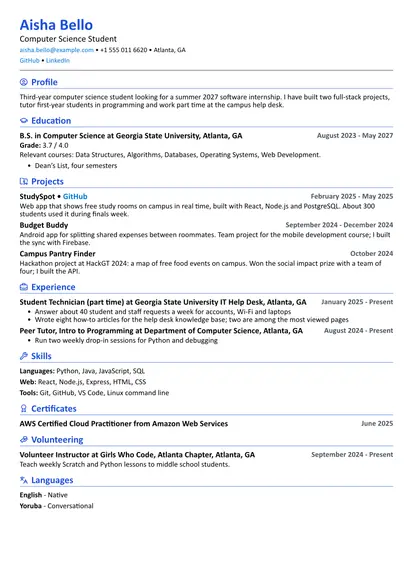
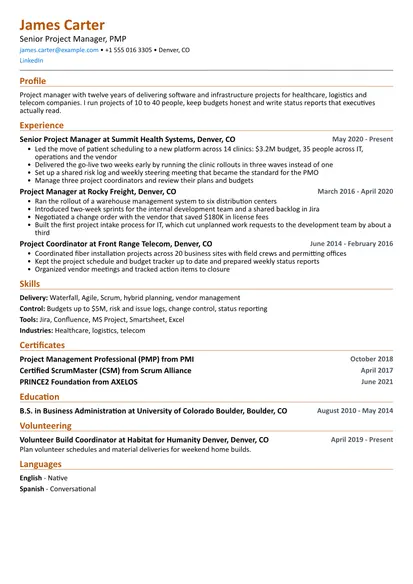
If you are still in school or just finished, move education above experience and include part time jobs and campus roles. The student template shows that order. If you are moving from support into operations or a coordinator role, the project manager template shows how to present process and team work.
Mistakes to avoid
- A summary full of adjectives ("hardworking, friendly, team player") with no facts
- Leaving out the channel, so the reader can't tell phone support from in store service
- Metrics without context, such as "95%" with no word on what it measured
- Listing duties that every agent had, like "answered calls"
- Skipping your second language because it isn't "perfect", when conversational support is often enough
- Customer names, account details or complaints described in a way that could identify someone
- Gaps or short jobs with no explanation when a one line note would help
- Typos. In a job built on clear written communication, they cost more than in most fields
Checklist before you send it
- Your summary names your years of experience and your main channels
- Each job shows the type of customer contact and some idea of volume
- At least one bullet per recent job includes a number or a clear result
- Systems from the job post that you have used appear in your skills section
- Every language you can support customers in is listed with an honest level
- The file is a PDF with your name in the file name