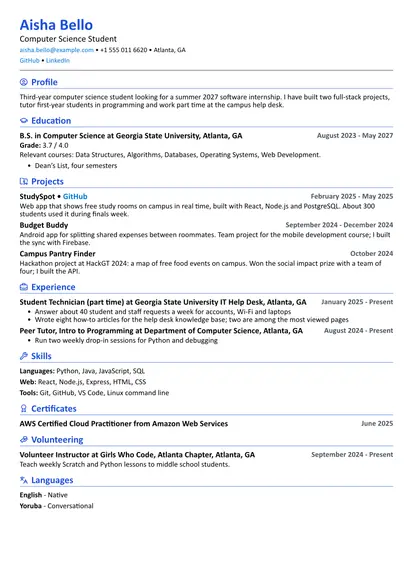
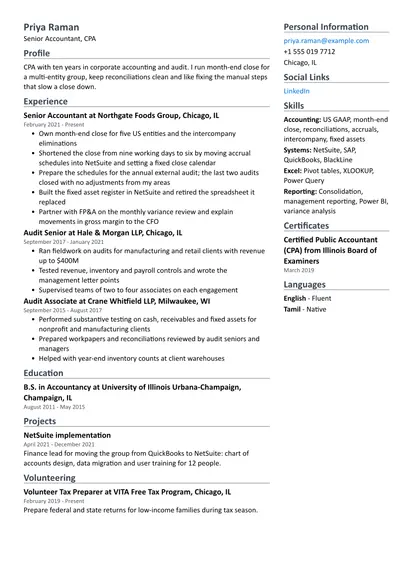
A store manager hiring a cashier usually has a stack of applications and a schedule with holes in it. They want to know three things quickly: will you show up for the shifts they need, will your drawer be right at the end of the night, and will customers leave in a better mood than they arrived. This template puts your experience and register skills at the top so those answers are easy to find. It uses the ATS Friendly layout, because most supermarket chains and large retailers take applications through an online system that reads plain, single-column resumes best.
The sample belongs to a part-time cashier with two years at a neighborhood supermarket and one holiday season in a toy store. Replace her details with yours and delete any section you don't need. If this is your first job, read the section on showing reliability with little experience before you start.
Template at a glance
| Setting | This template |
|---|---|
| Layout | ATS Friendly, single column with clear headings |
| Length | One page |
| Best for | Cashiers, retail associates, checkout and self-checkout hosts, first-job applicants |
| Section order | Summary, experience, skills, certificates, education, languages, volunteering |
| Also works in | Simple (a little more visual), Compact (fits more jobs on one page) |
What hiring managers look for
Front-end supervisors and store managers are not looking for poetry. They read for signs that you are dependable, honest with money and pleasant under pressure. A resume that makes those points with plain facts gets a call ahead of one full of adjectives.
Reliability comes first. A cashier who calls in sick on Saturdays costs the store more than a slow one, because someone has to cover the register. So anything that shows you keep commitments helps: long stays at one job, being asked back for another season, perfect attendance at school, or trust that grew over time, such as getting keys or closing duties.
Accuracy with money is next. Managers want to see that you balance your drawer, follow the rules for refunds and voids, and don't need someone to fix your mistakes. If you were the person trusted with the safe or the deposit, say so.
Then speed and manner. A good cashier keeps the line moving without making people feel rushed. Mention how busy the store was, the payment types you handled and how you dealt with complaints or returns. Finally, availability. Evenings, weekends and holidays are the hardest shifts to fill, and a clear line about when you can work is often the deciding detail.
How to write each section
Header and contact details
Your name, the job you are applying for, your city and state, a phone number you answer and an email address. Store managers often call rather than email, so set up a voicemail greeting that says your name. Use an email address made from your name. Leave off your full street address, a photo and your date of birth when applying in the US.
The line under your name can simply be "Cashier" or "Cashier and Retail Associate". If you are applying to a specific role such as "Front End Associate" or "Checkout Host", use the store's wording.
Summary
Two or three sentences: how much experience you have and where, one or two things you are good at, and when you can work. The availability line is the part many people skip and the part managers look for. These examples show the pattern:
First job: High school senior looking for a part-time cashier job after 3:30 pm on weekdays and all day on weekends. I ran the cash box for our band's fundraiser sales for two years and I'm comfortable talking to strangers.
Some experience: Cashier with two years of part-time experience in a busy neighborhood supermarket. My drawer has balanced at close on every shift this year, I know the self-checkout and returns desk, and I stay calm with long lines. Available evenings and weekends, including holidays.
Experienced or lead cashier: Head cashier with six years in grocery retail, three of them running the front end on evening shifts. I schedule eight cashiers, handle cash office counts and deposits, and train new hires on the register and loss prevention rules.
Experience
List jobs newest first. For each one give the store, your title, the city and the start and end month. One short line under the title can describe the store: its type, how many registers it has or how many hours a week you worked. That context tells a manager whether you are used to a quiet pharmacy counter or a twelve-lane supercenter.
Then three to five bullets for your current or most relevant job, and one to three for older ones. Aim each bullet at one of the things managers care about: volume, accuracy, trust, service or helping the team. Non-retail jobs belong here too. A delivery driver or restaurant server has handled money and customers, so describe those parts.
Skills
Group your skills so they are quick to scan, for example register skills, store tasks and customer service. Name the specific things you can do: cash handling, card and mobile payments, EBT or WIC transactions, returns and exchanges, price checks, age verification for alcohol and tobacco, opening and closing counts. If you know a register system by name and the job post mentions it, add it.
Skip vague traits like "hard-working" or "people person". Your bullets should prove those.
Certificates
Short and practical. A food handler card, first aid and CPR, an alcohol seller training course where your state requires one, or a store's internal cash office training all fit here. Give the name and the year. If you have none, delete the section. It won't count against you for an entry-level role.
Education
For most cashier jobs a single line is enough: your high school or GED and the year, plus any college or vocational classes you are taking now. If you are still in school, write the expected graduation year and mention your school schedule in your summary so the manager knows when you are free.
Languages and volunteering
A second language is a real advantage at the register, especially in neighborhoods where many customers speak it. List it with an honest level. Volunteering helps most when it involved people or money, such as checking in families at a food pantry or selling tickets for a school event.
Showing reliability with little experience
Many people applying for cashier jobs are looking for their first or second job. That is normal, and managers who hire for registers expect it. What they want is evidence that you will be on time, follow instructions, count money carefully and be polite. You can show all four without a single retail job.
Think about where you have done any of these things:
- Handled money: sold tickets, ran a bake sale table, collected dues for a club, worked a concession stand at games, sold things online or at a yard sale
- Kept a schedule: sports practice four days a week, a regular babysitting family, a paper route, a weekly volunteer shift, a perfect attendance award
- Served people: helped at a school open house, ushered at church or community events, answered phones for a family business, tutored younger students
- Been trusted: given keys to a space, put in charge of supplies, asked to train or watch over others
Write these up the same way as a job, with a title, the organization, the dates and one or two bullets. "Treasurer, Westland Robotics Club: collected dues from 25 members and kept a record that matched the bank statement" says more about cash handling than any skills list.
Availability matters most for first jobs. If you can work Friday nights, Sunday mornings or holiday weeks, put it in your summary. A teenager with open weekend availability and a good attendance record is a strong candidate for most part-time cashier openings.
If you have a gap or only short jobs, don't hide it. Keep the dates honest and let the bullets show what you learned. A manager would much rather hear that a summer job ended because school started than find out later.
Writing experience bullets
Start each bullet with a verb, say what you did and add a detail that shows scale or results. Numbers help when they are real: customers per hour, transactions per shift, number of registers, weeks without a cash discrepancy, people you trained. If you don't know an exact number, use a careful estimate you could explain, like "about 70 customers an hour on Saturdays".
A simple pattern: what you did + how much or how often + what it showed.
- Weak: "Responsible for the cash register."
- Better: "Ran a register in a store with eight lanes and balanced my drawer at close on every shift this year."
Examples by level
First job or entry level
- Collected and counted money at the school concession stand during home football games, then handed totals to the booster club treasurer
- Sold raffle tickets for the band fundraiser and kept a sales sheet that matched the cash box each night
- Babysat for two families every week for three years, including evenings and weekends
One to three years
- Served about 300 customers a shift at a supermarket register with cash, card, mobile pay and EBT
- Processed returns and exchanges at the customer service desk, following the receipt and manager approval rules
- Checked ID for alcohol and tobacco sales and refused sales without valid ID, with no compliance issues on store audits
- Picked up extra shifts during the holiday season and covered for coworkers on short notice
Lead or head cashier
- Ran the front end on evening shifts, assigning eight cashiers to registers, breaks and bagging
- Counted tills at shift change, prepared the nightly deposit and logged overages and shortages in the cash office report
- Trained new cashiers on the register, coupon policy and spotting counterfeit bills; most were working alone within their first week
- Reduced waiting at peak hours by opening backup lanes earlier based on the weekly sales pattern
Examples by store type
Supermarket and grocery
- Learned more than 100 produce codes by heart to keep the line moving without looking them up
- Bagged groceries with care for heavy items, eggs and bread, and offered carry-out help to older customers
- Ran a register in the express lane for 15 items or fewer during the weekday lunch rush
Convenience store and gas station
- Opened the store alone at 6 am: counted the starting till, turned on fuel pumps and stocked the coffee station
- Sold lottery tickets and handled payouts following the state lottery rules
- Kept the store clean and restocked the drink coolers between customers on overnight shifts
Department store and fashion
- Worked the fitting room and register, recommending sizes and matching accessories
- Opened store credit card accounts for customers who asked, explaining the terms clearly
- Folded and refilled tables after the morning rush and prepared the floor for new arrivals
Pharmacy and drugstore
- Rang up front-store sales and directed prescription questions to the pharmacy counter
- Followed the store's rules for restricted over-the-counter products and recorded sales as required
- Helped customers find products and checked prices for promotions and digital coupons
Self-checkout and front end
- Watched six self-checkout stations, cleared alerts, approved age-restricted items and helped customers with weighed produce
- Kept the front end stocked with bags, receipt paper and change for the registers
- Directed customers to open lanes during busy periods to keep waiting short
Skills and keywords
Many retailers screen applications with software before a person reads them. Use the same words as the job post when they are true for you. If the post says "point of sale (POS)", write that. If it says "cash handling", don't rename it.
| Category | Common examples |
|---|---|
| Register | Cash handling, POS systems, card and contactless payments, EBT and WIC, balancing a cash drawer, voids and refunds |
| Store tasks | Bagging, restocking, price checks, facing shelves, opening and closing procedures, inventory counts |
| Compliance | Age verification, coupon policy, loss prevention, counterfeit bill checks, food safety |
| Customer service | Greeting customers, handling complaints, returns and exchanges, loyalty program sign-ups |
| Work habits | Punctuality, flexible schedule, weekend and holiday availability, teamwork |
| Languages | Spanish, Vietnamese, Arabic or any other language you speak, with your level |
Basic math is part of the job, but writing "good at math" adds little. Showing that your drawer balances does the same job better.
Tailoring your resume to a job post
Retail jobs look alike, but the posts often differ in small ways that matter. A few minutes of editing for each application is worth it:
- Read the post and note the duties and schedule it mentions, such as early mornings, overnight, weekends or a minimum number of hours.
- Match your summary's availability line to their needs, as long as it is true.
- Use their job title in the line under your name, for example "Front End Associate", "Checkout Operator" or "Customer Service Cashier".
- Move your most relevant bullets to the top. For a pharmacy, lead with careful work and privacy. For a busy supermarket, lead with speed and volume.
- If the post lists specific tasks like stocking, lottery or fuel sales, mention them where you have done them.
If you apply through a store's online form, you will often also fill in your availability in a grid. Keep it consistent with what your resume says.
Formatting and length
One page, one font and a size between 10 and 12 points. Use the same date format for every job, for example "Jun 2024". Plain headings and bullets work best, both for application systems and for a manager reading on a phone at the customer service desk.
Save the file as a PDF with your name in it, such as "Jasmine-Carter-Resume.pdf". If you hand in a printed copy at the store, bring it in a folder so it stays clean, and ask for the manager by name if you can. A neat page and a short, polite introduction at a quiet time of day still work well in retail.
Why the sections are in this order
The template puts experience right after the summary, then skills. For a cashier, what you have done at a register or with customers is the best evidence of what you will do next, and the skills section backs it up with the exact terms a hiring system searches for.
Certificates and education come after, because for most register jobs they are useful but rarely decide who gets hired. If you have no job history yet, move education and volunteering up and lean on the student template, which leads with school and activities. If you are moving from the register toward the cash office or bookkeeping, look at the accountant template to see how money-handling work is described further along that path.
Mistakes to avoid
- No availability anywhere on the page, so the manager has to guess
- A summary full of adjectives ("dedicated, motivated, energetic") and no facts
- Listing duties every cashier has, such as "used the register", without anything that shows how well you did it
- Claiming numbers you can't explain, like "100% accuracy" when you never checked
- Leaving out non-retail jobs that show reliability or customer contact
- An email address that is a joke or a nickname
- A two-page resume for two short jobs
- Typos. A cashier is trusted with details, and spelling mistakes suggest the opposite
Checklist before you send it
- Your phone number is correct and your voicemail says your name
- The summary says when you can work
- At least one bullet shows cash handling accuracy or trust with money
- Store type, volume or payment types are mentioned somewhere
- Terms from the job post that are true for you appear on the page
- Dates are consistent and nothing is hidden or stretched
- Everything fits on one page and the file is a PDF named after you